

Published on October 13, 2025

Addressing vitamin D levels at any stage of breast cancer diagnosis can lead to better outcomes
Key Points
- Research has shown an 82% lower rate of getting breast cancer among women with vitamin D levels of at least 60 ng/ml (150 nmol/L) versus below 20 ng/ml (50 nmol/L)
- At the time of diagnosis, women whose vitamin D level was 30 ng/ml (75 nmol/L) or higher had a 27% lower risk of death compared to women whose vitamin D level was below 20 ng/ml (50 nmol/L)
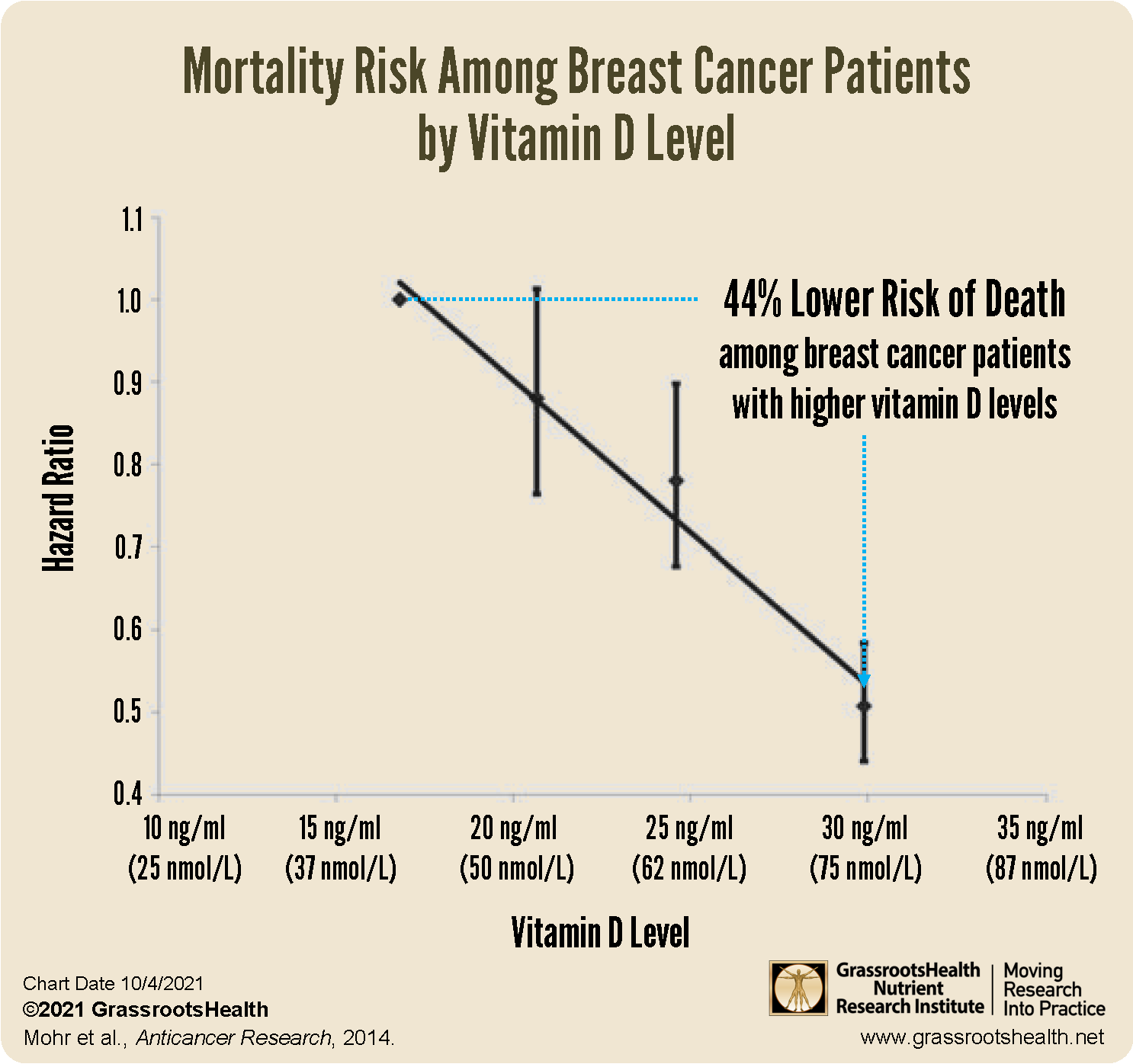
- Another study showed that breast cancer patients with the highest vitamin D levels (average of 30 ng/ml or 75 nmol/L) after diagnosis had a 44% lower risk of breast cancer related death compared to those with the lowest vitamin D levels (an average of 17 ng/ml or 42 nmol/L)
 Every October, GrassrootsHealth celebrates Breast Cancer Prevention, and reviews the overwhelming evidence showing the significant relationship between higher vitamin D levels and a lower risk of getting breast cancer. In fact, a paper published by GrassrootsHealth showing an 82% lower rate of breast cancer among women with vitamin D levels of at least 60 ng/ml (150 nmol/L) versus women with vitamin D levels below 20 ng/ml (50 nmol/L) was labeled among the top 10% most cited papers in 2018 for that journal. This is true PREVENTION!
Take Vitamin D Action Before Diagnosis: Breast Cancer Survival Linked to Vitamin D Level
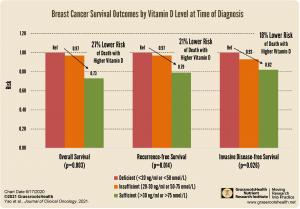 Research from Roswell Park Comprehensive Cancer Center and Kaiser Permanente by Yao et al., Clinically sufficient vitamin D levels at breast cancer diagnosis and survival outcomes in a prospective cohort of 3,995 patients after a median follow-up of 10 years, summarized initial findings from Kaiser Permanente Northern California’s Pathways Study, involving women diagnosed with incident invasive breast cancer between 2006 and 2013, and their risk of death. This study found that women whose vitamin D level at the time of diagnosis was 30 ng/ml (75 nmol/L) or higher had a 27% lower risk of death compared to women whose vitamin D level was below 20 ng/ml (50 nmol/L).
Vitamin D Lowered Rates of Metastatic Cancer and Cancer Death in Large RCT
 Yesterday, October 13th, was Metastatic Breast Cancer Awareness Day. Metastatic cancer (also known as Stage 4 cancer) is a cancer that has spread from its primary location to other tissues or organs in the body. According to breastcancer.org, approximately 30% of early-stage breast cancers will eventually become metastatic breast cancer.
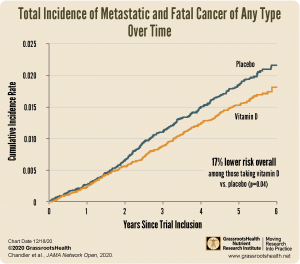
In 2020, Chandler et al. completed a secondary analysis of the VITAL randomized clinical trial data to determine the effect of daily 2,000 IU vitamin D supplementation on the development of advanced, metastatic cancer and cancer death with BMI (grouped as below 25, 25 to under 30, and above 30) included to see if it modified the effects of supplementation.
A total of 1,617 participants were diagnosed with invasive cancer, with an average follow up time of 5.3 years. Supplementation with vitamin D did reduce the incidence of metastatic or fatal cancer in the overall cohort. Of those diagnosed, 226 (1.7%) had been receiving vitamin D and 274 (2.1%) had been receiving a placebo. Overall, there was a 17% reduced risk of metastatic or fatal cancer among the vitamin D group versus the placebo group (p=0.02). When taking BMI into consideration the reduction in cancer was more pronounced. A significant reduction of metastatic or fatal cancer was seen among those with a normal BMI, with a decreased risk of 38% among those taking vitamin D compared to placebo (p=0.004).
Could Addressing Vitamin D After Breast Cancer Diagnosis Still Provide a Benefit?
Many studies have found that women with higher vitamin D levels have a lower risk of developing breast cancer. But what about women who do get diagnosed or who already have breast cancer? Could vitamin D still help them?
The findings above by Yao et al. are similar to those from a review published in 2014 by a group out of the University of California, San Diego. Mohr et al., along with GrassrootsHealth’s Principle Investigator Dr. Cedric Garland, completed an analysis of five studies, which included a total of 4,443 breast cancer patients, to determine the relationship between vitamin D level and breast cancer survival among women already diagnosed with breast cancer. When looking at the combined data, higher vitamin D levels were related to substantially lower rates of death from breast cancer. Compared to patients in the group with the lowest vitamin D levels (an average of 17 ng/ml or 42 nmol/L), breast cancer patients in the group with the highest vitamin D levels (average of 30 ng/ml or 75 nmol/L) had a 44% lower risk of breast cancer related death. (p<0.0001)
 Click to Enlarge & Print
In fact, when looking at the direct relationship between vitamin D level and breast cancer fatality, the vitamin D level accounted for 97% of the variance. This means that when considering other factors that may influence breast cancer mortality, the vitamin D level made almost all the difference.
Another Study Shows It’s Not Too Late to Start Vitamin D After Diagnosis
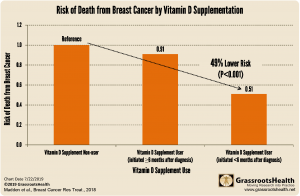 In July 2018, Madden et al. published results from a study assessing the relationship between vitamin D supplement use initiated after a breast cancer diagnosis and associated mortality among 5,417 women in Ireland aged 50 to 80 years old. Supplement users were those who were taking more than 400 IU/day and were categorized as starting either within 6 months of diagnosis or more than 6 months after diagnosis. Overall, there was a 20% lower risk of death from breast cancer among those who started using vitamin D supplements after diagnosis compared to those who didn’t (P=0.048). If vitamin D supplementation was initiated within 6 months of diagnosis, there was a 49% lower risk (P<0.001).
Address Your Vitamin D Level – No Matter What Stage (of Life) You Are In
Deficiency of vitamin D, at any age or any stage of life, will not benefit health, and can only bring potential harm. Avoid deficiency at all costs – test your levels today and take the steps necessary to achieve a target level you see fit for your health.
The Importance of Getting Enough of All Nutrients
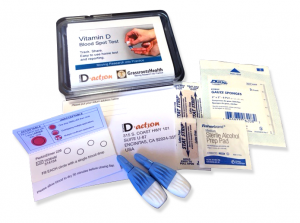 Having and maintaining healthy vitamin D levels and other nutrient levels can help improve your health now and for your future. Choose which to measure, such as your vitamin D, omega-3s, and essential minerals including magnesium and zinc, by creating your custom home test kit today. Take steps to improve the status of each of these measurements to benefit your overall health. You can also track your own intakes, symptoms and results to see what works best for YOU.
Enroll and test your levels today, learn what steps to take to improve your status of vitamin D (see below) and other nutrients and blood markers, and take action! By enrolling in the GrassrootsHealth projects, you are not only contributing valuable information to everyone, you are also gaining knowledge about how you could improve your own health through measuring and tracking your nutrient status, and educating yourself on how to improve it.
How Can You Use this Information for YOUR Health?
Having and maintaining healthy vitamin D and other nutrient levels can help improve your health now and for your future. Measuring is the only way to make sure you are getting enough!
STEP 1 Order your at-home blood spot test kit to measure vitamin D and other nutrients of concern to you, such as omega-3s, magnesium, essential and toxic elements (zinc, copper, selenium, lead, cadmium, mercury); include hsCRP as a marker of inflammation or HbA1c for blood sugar health
STEP 2 Answer the online questionnaire as part of the GrassrootsHealth study
STEP 3 Using our educational materials and tools (such as our dose calculators), assess your results to determine if you are in your desired target range or if actions should be taken to get there
STEP 4 After 3-6 months of implementing your changes, re-test to see if you have achieved your target level(s)
You may also like
 Does your weight affect how much Omega-3 you need?
 Is Silent, Low-Level Inflammation Contributing to Your Mental & Physical Disease Risk?
 Health Loss from Brain Disorders Now Surpasses Cardiovascular Disease and Cancer
 Here We Go Again (Part 3 of 3) – Did the VITAL Analysis Meet the Nutrient Study Criteria for Fracture Rates?