
Published on May 3, 2026

Tips for safely utilizing sun exposure to produce vitamin D, how vitamin D made in your skin provides additional benefits beyond vitamin D supplements, plus several myths about sunshine and vitamin D
Key Points
- Developing a safe, personalized plan that incorporates sunshine exposure into your regular routine – to maximize overall benefits while making vitamin D in your skin (which has additional benefits beyond vitamin D taken orally) – can be easily done when considering the following factors
- If the length of your shadow on the ground is shorter than your height, the sun is high enough in the sky to let UVB rays shine through and reach the ground, and your skin, which is usually mid-day between the hours of 10 am and 2 pm. Early morning and early evening, when our shadows are longer than we are tall, only provide us with UVA sunlight (good for making nitric oxide), not UVB which is necessary for vitamin D production.
- Knowing your skin type is essential for personalizing your sun exposure; darker skin contains more melanin, which acts as a natural sunscreen and decreases the likelihood of burns and skin cancer, however, the more melanin skin contains the longer it takes to produce vitamin D
- Read more for additional factors, myths about vitamin D & sunshine, and how to tell if you are getting enough vitamin D

We begin our 11th Annual Sunshine Month with a focus on vitamin D, knowing full well that there are many additional health benefits resulting from sun exposure. We look forward to exploring those topics throughout the remainder of the month!
Exposure to sunshine initiates many reactions within the body that affect our health, the most notable of which is vitamin D production. And, while there are many reasons that most people cannot rely on sunshine exposure alone to get the amount of vitamin D they need year-round, there are several unique benefits to making vitamin D from the sun compared to taking vitamin D as a supplement that might encourage individuals to utilize both whenever possible. For example, the vitamin D that our body makes in the skin upon exposure to UVB plays a role in protecting skin cells from residual UV damage and decreasing the risk of melanoma.
Balance is KEY
A 2025 paper by Ucar and Holick titled Illuminating the Connection: Cutaneous Vitamin D3 Synthesis and Its Role in Skin Cancer Prevention highlights the relationship between sun exposure, vitamin D, and skin cancer. UVB from sunlight initiates the production of vitamin D₃ in the skin; meanwhile, it can also induce DNA damage and oxidative stress, contributing to skin cancer development. Importantly, the paper underscores that vitamin D deficiency, affecting over half the global population, is itself associated with increased risks of chronic diseases, including cancers, autoimmune conditions, and cardiovascular disease.
A key message from this paper is that sunlight exposure is not inherently harmful but must be balanced. Moderate, regular exposure supports vitamin D production and broader health benefits, such as nitric oxide release for blood pressure and immune modulation. Excessive or intermittent exposure, especially that which leads to sunburn, increases skin cancer risk.
Sunlight, Lifestyle, and Vitamin D: One Size Doesn’t Fit All
Another 2024 paper by Grant et al., Determinants of vitamin D levels from sun exposure: a global perspective, highlights a central truth about vitamin D: while UVB exposure from sunshine is meant to be the primary source of vitamin D for most people, the amount each person produces varies dramatically based on a complex mix of environmental, biological, and lifestyle factors. Vitamin D status, measured as serum 25(OH)D, is not determined by sunlight alone, but by how sunlight interacts with variables such as skin pigmentation, time of day, season, latitude, cloud cover, and the amount of skin exposed. Behaviors like sunscreen use, clothing choices, and time spent outdoors can significantly reduce vitamin D production, while baseline vitamin D levels and body composition influence how much levels rise with sun exposure. Importantly, the body has built-in safeguards so that excess UV exposure actually degrades vitamin D precursors, meaning you cannot overdose on vitamin D from sunlight alone.
This study emphasizes a strong case for personalized, balanced sun exposure rather than blanket avoidance. Achieving optimal vitamin D levels may require substantial daily sunlight exposure in some populations, especially those with darker skin or low baseline levels, while others could reach adequate levels with less exposure. At the same time, modern lifestyles, such as indoor living, sun avoidance, cultural practices, and urban environments, have contributed to widespread vitamin D insufficiency worldwide.
This is yet another paper that reinforces our key message this Sunshine Month: sunlight is essential but must be balanced and optimized, not avoided. Because so many factors limit natural vitamin D production, a combined strategy of sensible sun exposure, testing, and often, supplementation, is necessary to help individuals achieve and maintain optimal levels.
How to Make Vitamin D from Sunshine
Overall, having a “balanced exposure” paradigm is essential: avoid sunburn and excessive exposure while recognizing that sensible sunlight is biologically necessary, not only for vitamin D production but also for activating protective pathways that may help reduce disease risk, including certain skin cancers.
Unfortunately, we are not always able to make vitamin D any time the sun is shining. Additionally, in today’s modern society, many individuals unintentionally create their own “vitamin D winter” by staying indoors on hot, sunny days, covering up when outside, or avoiding the sun during peak vitamin D-producing UVB hours (mid-day). The post below outlines several important factors to consider when choosing to use sunshine to produce vitamin D, how to be safe with your sun exposure routine, and how to know if you are generating enough vitamin D or if a supplement may be needed for additional support.
Watch the Videos
 Making Vitamin D From the Sun
 Making Vitamin D From the Sun
Learn how to make vitamin D from sunshine. The UV index must be above 3, your shadow must be shorter than you and the more skin exposed the more vitamin D you will make. Know your skin and skin type. Don’t burn.
Watch Now
How does the color of the skin affect vitamin D production?
 How does the color of the skin affect vitamin D production?
Those with darker skin (and therefore, more melanin) require more time to be in the sun exposed to UVB than those with lighter skin to make the same amount of vitamin D. Learn more with this interview snippet with Dr. Michael Holick.
Watch Now
Does sunscreen block vitamin D production?
 Does sunscreen block vitamin D production?
Listen in to this snippet of an interview with Dr. Michael Holick as he describes the scientific purpose of sunscreen and if you can still make vitamin D while appropriately applying sunscreen to the skin.
How is vitamin D made by the sun different from vitamin D in supplements?
 How is vitamin D made by the sun different from vitamin D in supplements?
Watch this snippet of a video interview with Dr. Michael Holick, as he describes some of the differences between vitamin D when made in the skin and vitamin D when taken orally.
How is Vitamin D Produced in the Skin, and How is it Different from Vitamin D taken Orally?
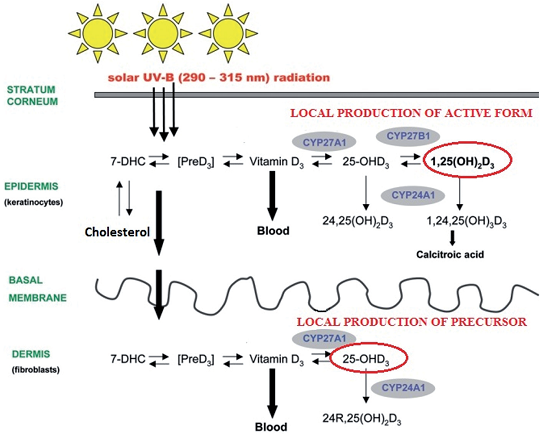
Exposure of the skin to UVB radiation initiates the conversion of cholesterol to pre-vitamin D3, which can then be further converted into other photoproducts that have their own unique biological properties, including playing a role in reducing the risk of skin cancer. Pre-vitamin D3 is also converted into other forms of vitamin D, including its active form, directly within the skin cells for their own use, as illustrated in the diagram below.
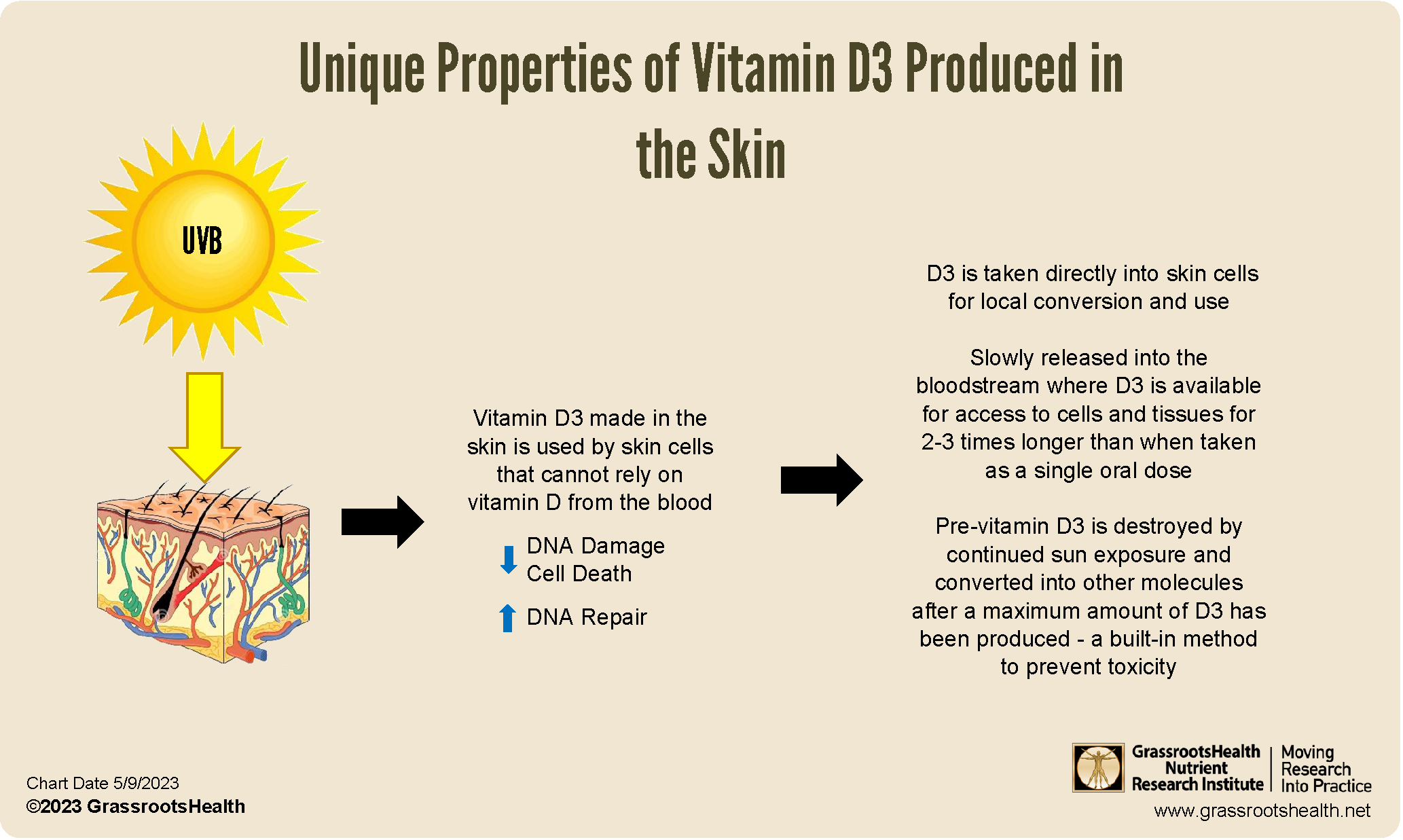
When pre-vitamin D3 is made in the skin it is converted slowly into vitamin D3 and released into the bloodstream over a couple of hours, allowing the vitamin D to be available in the bloodstream 2-3 times longer than that absorbed through the gut.
Additional Unique Attributes of Vitamin D Produced by Sunlight
Vitamin D synthesis itself depends on several factors, including skin pigmentation, sunscreen use, latitude, season, time of day, and age, all of which can significantly reduce UVB-driven production and contribute to widespread deficiency. When vitamin D is produced in the skin,
- Vitamin D and its photoproducts may actively protect the skin, helping repair DNA damage, reduce inflammation, and inhibit abnormal cell growth.
- The active form, 1,25(OH)₂D₃, has demonstrated anti-cancer properties, including reducing UV-induced DNA damage (e.g., cyclobutane pyrimidine dimers), promoting repair, and regulating cell proliferation and apoptosis directly within the skin cells.
- Sunlight-generated compounds beyond vitamin D (e.g., lumisterol and other photoproducts) may also contribute anti-inflammatory and anti-tumor effects, suggesting sunlight has broader biological benefits than vitamin D alone.
- Epidemiological data indicate that complete sun avoidance may carry health risks, with some studies showing shorter life expectancy and increased disease risk compared to those with moderate sun exposure (much more to come on this topic!).
Vitamin D Produced in the Skin Helps Protect the Skin
As mentioned in the study above, vitamin D made in the skin has antioxidant effects that can decrease DNA damage in the skin cells and facilitate DNA repair directly upon any UV damage, help prevent cell death, and help protect from melanoma, a serious form of skin cancer. Furthermore, sensible exposure to sunlight actually protects the skin and deeper tissues from UV damage by increasing pigmentation (short term tanning and avoidance of sunburn) and thickening the outermost layer of skin – a process beneficial even for those with already darker skin.
In fact, keratinocytes, which make up over 90% of the outermost layer of skin, cannot rely on vitamin D3 from supplements. Keratinocytes must synthesize their own supply of vitamin D directly from sun exposure (as illustrated in the diagram above), or by topical application as described in a review by Bolerazska et al..
Factors Affecting Vitamin D Production from Sun Exposure
When it comes to using sunshine exposure to create vitamin D, it is essential to do so purposefully and mindfully. The potential harms of excessive UV exposure (the kind that results in sunburn) include the increased risk of melanoma and other forms of skin damage, so it is essential to keep in mind the number one rule of safe sun exposure:
Don’t burn!
In fact, when your skin starts to get a sunburn, the ability to make vitamin D breaks down, so you want to avoid sunburns for vitamin D production among other important reasons. Developing a personalized plan that incorporates sunshine exposure into your regular routine to maximize the benefits and make vitamin D, while being mindful not to burn, can be easily done when considering the following factors.
Make Sure the Ultraviolet (UV) Index is Above 3
The ultraviolet (UV) Index is a measurement of the strength of the sun’s UV rays at a particular place and time. An index of 0 occurs at night when there is no UV radiation and an index of 10 corresponds approximately to mid-day summer sunlight without cloud cover (values above 10 can be found in high altitudes, near the Equator, and locations with higher ozone layer depletion).

The UV Index must be over 3 to make vitamin D, however, the UV Index varies tremendously depending on the time of day, time of year, latitude, weather, air pollution, and geographical location. Keep in mind, thick clouds and fog, as well as air pollution, can effectively block UVB.
HINT: Are You Taller than Your Shadow?
While you are outside in the sunshine, look at your shadow. Is it shorter than you are?
If so, there is enough UVB for you to make vitamin D! Check your weather app to make sure the UV Index is above 3, as this is when you’ll really start making vitamin D.
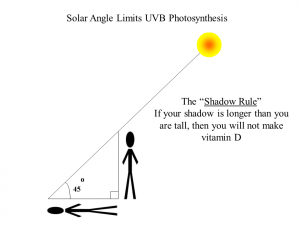 If the length of your shadow on the ground is shorter than your height, the sun is high enough in the sky to let UVB rays shine through and reach the ground, and your skin. This is usually mid-day, between the hours of 10 am and 2 pm. Early morning and early evening, when our shadows are taller than we are, only provide us with UVA sunlight (good for making nitric oxide), not UVB which is necessary for vitamin D production.
Latitude and Season
Vitamin D production is also dependent on latitude and season. Those who live closer to the equator, where the midday sun is high in the sky throughout the year, have the ability to produce vitamin D year-round.
Those who live north of about 34 degrees latitude (approximately Los Angeles, CA, or Atlanta, GA) experience a “vitamin D winter” for some period of time between fall and early spring, when the sun never gets high enough in the sky to enable vitamin D production.
Skin Type and Color
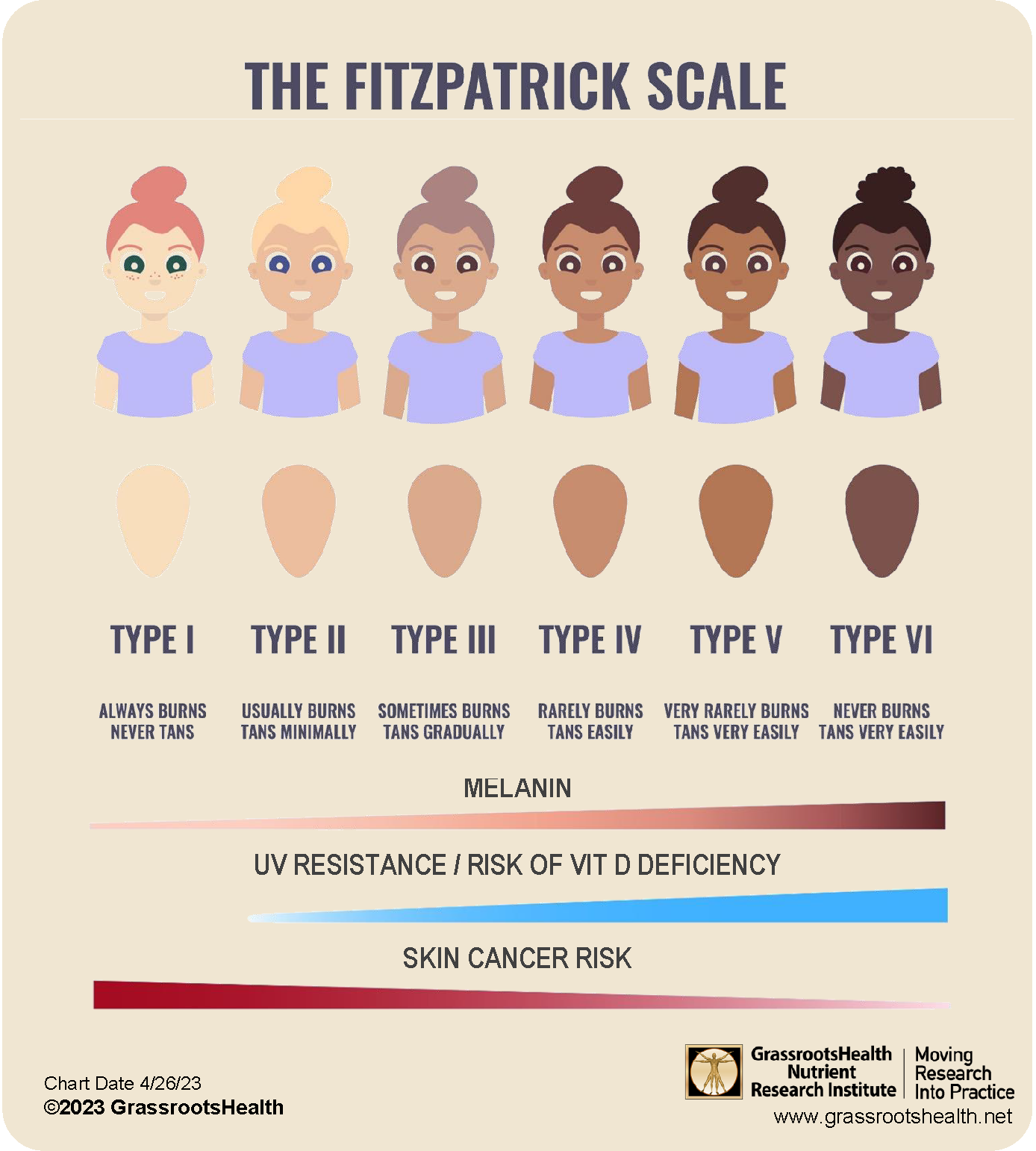
Knowing your skin type is essential for personalizing your sun exposure. Darker skin contains more melanin, which acts as a natural sunscreen. While this decreases the likelihood of burns and skin cancer, the more melanin skin contains the longer it takes to produce vitamin D. For example, a person with skin type VI may require more than 10 times the length of UVB exposure to make the same amount of vitamin D as someone with skin type II.
The Fitzpatrick scale, shown below, classifies six skin types based on their response to UV radiation. The skin type quiz can help you determine your type.
IMPORTANT SUMMARY!
Darker skin = lower risk for skin cancer but higher risk of vitamin D deficiency
Lighter skin = higher tendency to burn, higher risk of skin cancer, yet sun avoidance will require vitamin D supplementation
Clothing and Sunscreen
Skin must be exposed to sunlight without sunscreen or clothing in order to make vitamin D. Greater amounts of vitamin D are made when more skin is exposed, especially the back and shoulders, as these contain the most surface areas on your body. It is better to expose more skin for less time to ensure you do not overexpose yourself and burn. Ideally, skin should be exposed to the sun on a 90-degree angle.
When to Apply Sunscreen?
Since sunscreen blocks the UVB rays needed to produce vitamin D, it should be applied only after the exposure time allotted for making vitamin D. Sunshine expert, Dr. Michael Holick, typically recommends covering up the sensitive parts of the skin (face, top of the hands, ears) but exposing the larger surfaces of the body (arms and legs), without sunscreen, for a reasonable amount of time and without burning to make vitamin D and the other biochemicals resulting from sunshine exposure before covering up.
[People with low risk of skin cancer] are advised to spend sufficient time outdoors with ample skin exposed when the UV index is >3 to obtain a vitamin D-effective dose of UV radiation. Sun protection is not needed unless spending extended time outdoors when the UV index is >3. Neale et al.
Sunscreen Trick: A meta-analysis by Gatta et al. confirms that sunscreen blocks vitamin D synthesis. Spend your first 10-30 minutes outside exposing your skin to the sun without sunscreen; then, depending on your skin type, determine if sunscreen should be applied to avoid sunburn.
Age
Vitamin D3 production slows with age. Older adults are considered an at-risk group for vitamin D deficiency, one of the reasons being that age decreases the amount of the precursor of vitamin D3 in skin so that less vitamin D3 can be produced in response to UVB exposure. A 2020 publication by Chalcraft et al. clearly demonstrated a pattern of decline in vitamin D3 production with age. Using a model based on data from the study, they found a 13% decrease in the production of vitamin D3 with each decade of life, with the estimated production cut nearly in half at the age of 70 years compared to production at the age of 20.
Time Yourself So You DON’T BURN!
The amount of time spent in the sun can be personalized according to skin type and UV Index. Once you have identified your skin type, you can use tools such as the free dminder app to approximate how much time you can spend in the sun without burning.
Once you have exposed your skin (without sunscreen) for your allotted time, get out of the sun or cover up.
Study Illustrates Influence of Ethnicity, BMI, and Age on How Vitamin D Levels Respond to UVB Exposure
 A study published in April 2024 by Brennan et al. looked at data from 438,978 participants residing in the UK. The UVB dose received by each individual over the 135 days prior to their vitamin D blood level draw was calculated with the purpose of determining the association between UVB exposure from sunshine and other factors that could affect vitamin D levels.
The authors found that, while overall vitamin D levels did improve with increased calculated doses of UVB, the effect varied by ethnicity and age. In fact, vitamin D levels differed significantly by ethnicity, with average levels of 10.2 ng/ml (25.4 nmol/L) among Asians, 12.2 ng/ml (30.6 nmol/L) among Blacks, and 19.2 ng/ml (47.9 nmol/L) among Whites. (NOTE: These are all deficient vitamin D levels!) The study also found that, while UVB dose was strongly associated with vitamin D levels among all ethnicities, it was the most important predictor of vitamin D level only among Whites, while vitamin D supplementation was the most important predictor among Asians and Blacks.
Other factors that were significantly associated with vitamin D levels, besides calculated UVB dose, included BMI, age, oily fish consumption, and cholesterol levels.
Sunshine Myths Addressed
It is Not Possible to Become Toxic from Vitamin D Produced by Sun Exposure
Vitamin D toxicity is rare and usually caused by excessive vitamin D supplementation, which can lead to hypercalcemia (increased calcium in the blood), hyperphosphatemia (increased phosphate in the blood), and suppressed serum PTH concentrations. Symptoms include vomiting, nausea, abdominal pain, fatigue, and weakness. Most cases of vitamin D toxicity have been related to supplement manufacturing and labeling errors, as well as overdosing (seen in some cases with intakes of 50,000 IU/day or more over an extended period of time such as six months or longer), or over-correction of vitamin D deficiency (seen with intakes of about 77,000 IU/day for two months).
While vitamin D toxicity is possible to achieve from supplements, it is not possible when generating vitamin D from sun exposure. In fact, the pre-vitamin D made by sunlight can also be destroyed by sunlight, and converted into other molecules after a maximum amount of vitamin D3 has been created.
In other words, sunlight provides the fail-safe where the excess vitamin D3 can be broken down by UV light directly within the external layer of the skin before making it into the bloodstream.
Other Factors
Cloud coverage, air pollution, and shade cast off from buildings all disrupt the direct contact of sunlight on our skin, and therefore, vitamin D production.
Vitamin D & Sunshine Myths
The skin cannot produce vitamin D from sunlight shining through a window – so do not assume you are getting your D while driving in your car with the AC on and windows up. The windows block the UVB from sunlight.
You cannot wash vitamin D produced in the skin off! No worries if you take a shower after spending some time at the beach – you’ll do a good job of washing the sand off, but that vitamin D (which was produced in the deeper layers of the skin) will remain.
Don’t expect to make vitamin D while also slathering on the sunscreen. Sunscreen should absorb both UVA and UVB radiation – with about 97% absorption with SPF of 30. While this may allow someone to be in the sun 30 times longer, it will block vitamin D production.
Don’t expect to make enough vitamin D exposing just the arms and legs for 5-10 minutes a day. It likely is not enough for almost anyone!

This Sunshine Month, save ~25% on 2 Vitamin D test kits (for before and after summer sun) plus the Sunshine eBook with our Sunshine Month Bundle here!
Measuring is the Only Way to Know if You Are Getting Enough Vitamin D. Test At Home!
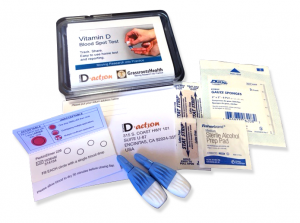 Having and maintaining healthy vitamin D levels and other nutrient levels can help improve your health now and for your future. Choose which additional nutrients to measure, such as your omega-3s and essential minerals including magnesium and zinc, by creating your custom home test kit today. Take steps to improve the status of each of these measurements to benefit your overall health. With measurement you can then determine how much is needed and steps to achieve your goals. You can also track your own intakes, symptoms and results to see what works best for YOU.
Enroll in D*action and Test Your Levels Today!
How Can You Use this Information for YOUR Health?
Having and maintaining healthy vitamin D and other nutrient levels can help improve your health now and for your future. Measuring is the only way to make sure you are getting enough!
STEP 1 Order your at-home blood spot test kit to measure vitamin D and other nutrients of concern to you, such as omega-3s, magnesium, essential and toxic elements (zinc, copper, selenium, lead, cadmium, mercury); include hsCRP as a marker of inflammation or HbA1c for blood sugar health
STEP 2 Answer the online questionnaire as part of the GrassrootsHealth study
STEP 3 Using our educational materials and tools (such as our dose calculators), assess your results to determine if you are in your desired target range or if actions should be taken to get there
STEP 4 After 3-6 months of implementing your changes, re-test to see if you have achieved your target level(s)