
Published on April 7, 2026

Could limiting vitamin D recommendations unintentionally limit the full spectrum of its health benefits?
Key Points
- Optimal vitamin D levels may extend beyond the recommended 40–60 ng/mL range, with emerging evidence supporting a broader target of 40–80 ng/mL.
- Higher serum 25(OH)D levels are associated with reduced risk of infections, chronic diseases, and cancer, with added benefits often seen above 50–60 ng/mL.
- Research from scientists like Dr. Michael Holick and Dr. William Grant demonstrates a clear dose-response relationship between vitamin D levels and disease risk reduction.
- Achieving optimal vitamin D status is a personalized process that requires measuring, optimizing intake, and retesting to reach and maintain target levels.

For more than 15 years, GrassrootsHealth and a panel of leading vitamin D scientists have stood behind our Scientists’ Call to D*action with a clear, evidence-based public health message: achieving a serum 25-hydroxyvitamin D [25(OH)D] level of 40–60 ng/mL (100-150 nmol/L) is essential for optimal health. This target was established in 2007 through collaboration among dozens of international experts and remains a powerful, research-supported benchmark for reducing disease risk and addressing the global vitamin D deficiency epidemic.
However, with more than a decade of additional research and extensive real-world data, important questions have emerged about whether this range fully captures vitamin D’s potential. While consensus among all panel members remains at 40–60 ng/mL, several scientists now strongly suggest that limiting recommendations to this range may unintentionally limit the full spectrum of health benefits, particularly for immune function, chronic disease prevention, and longevity.
With this in mind, a growing body of evidence supports a broader target of 40–80 ng/mL, with higher levels (often above 50–60 ng/mL) associated with additional benefits across multiple health outcomes. This expanded perspective reflects an evolving understanding that optimal vitamin D status is not one-size-fits-all, and that higher levels may be necessary to fully support human health.
Evolving the Target for Optimal Vitamin D
Over the last several years, many guidelines and practitioners have suggested differing serum 25(OH)D levels for sufficient health, from 20 ng/mL (Institute of Medicine) or 32 ng/mL (Endocrine Society), to 40–60 ng/mL (GrassrootsHealth). However, emerging research suggests that even this range may underestimate the full potential of vitamin D.
A growing body of evidence indicates that the optimal range for serum 25(OH)D may be 40–80 ng/mL, not 40–60 ng/mL. Importantly, staying below 60 ng/mL may leave up to 20% of potential health benefits unrealized, particularly in areas related to immune function, chronic disease prevention, and overall mortality.
Vitamin D and Immune Defense
Vitamin D plays a critical role in supporting the immune system, particularly in defending against infections. Research such as that reviewed by Dr. Sunil Wimalawansa has shown that rapidly increasing serum 25(OH)D levels can enhance immune responses, including protection against severe infections such as sepsis and COVID-19. This highlights an important principle: not only is maintaining sufficient vitamin D important, but when needed, achieving optimal levels quickly may provide additional protective benefits.
Vitamin D and Cancer Outcomes
Vitamin D’s influence extends beyond immediate immune defense into long-term disease risk. A systematic review examining vitamin D and cancer outcomes found that higher vitamin D status is associated with reduced cancer incidence and mortality.
Additionally, data from GrassrootsHealth and related analyses suggest that extra protective benefits may be achieved at serum levels above 60 ng/mL. A pooled analysis of randomized trials and a prospective cohort found that women with 25(OH)D levels ≥60 ng/mL had approximately 80% lower risk of breast cancer compared to those with levels below 20 ng/mL.
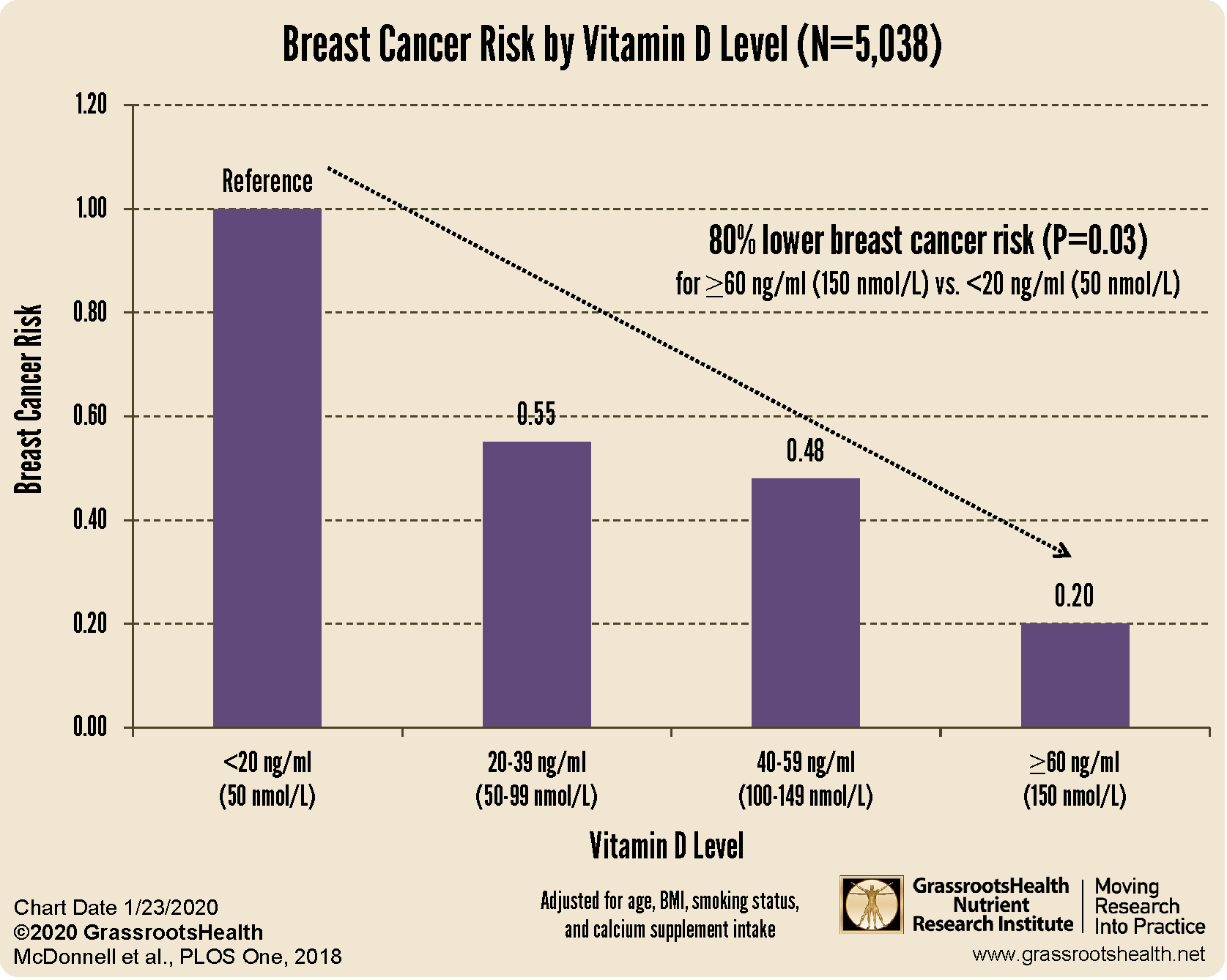
Similarly, a meta-analysis of 70 observational studies demonstrated a clear dose-response relationship, showing that increasing vitamin D levels from 20 to 60 ng/mL was associated with a 71% lower risk of breast cancer. Together, these findings reinforce two key points: first, that vitamin D plays a critical role in regulating processes such as cell growth, immune surveillance, and inflammation; and second, that the greatest reductions in cancer risk appear at higher serum levels, particularly at or above 60 ng/mL.
These observations support the broader perspective that optimizing vitamin D status beyond the 40-60 ng/mL range may offer additional protection against cancer development and progression.
Higher Levels for Chronic Disease Prevention
Maintaining higher serum 25(OH)D concentrations, particularly above 50 ng/mL, has been associated with meaningful benefits across a range of chronic conditions.
Research on vitamin D sufficiency and disease control indicates that higher vitamin D status supports both chronic disease management and protection against acute infections. Extensive reviews by Dr. Michael Holick and Dr. William Grant provide further insight into how vitamin D status influences chronic disease risk.
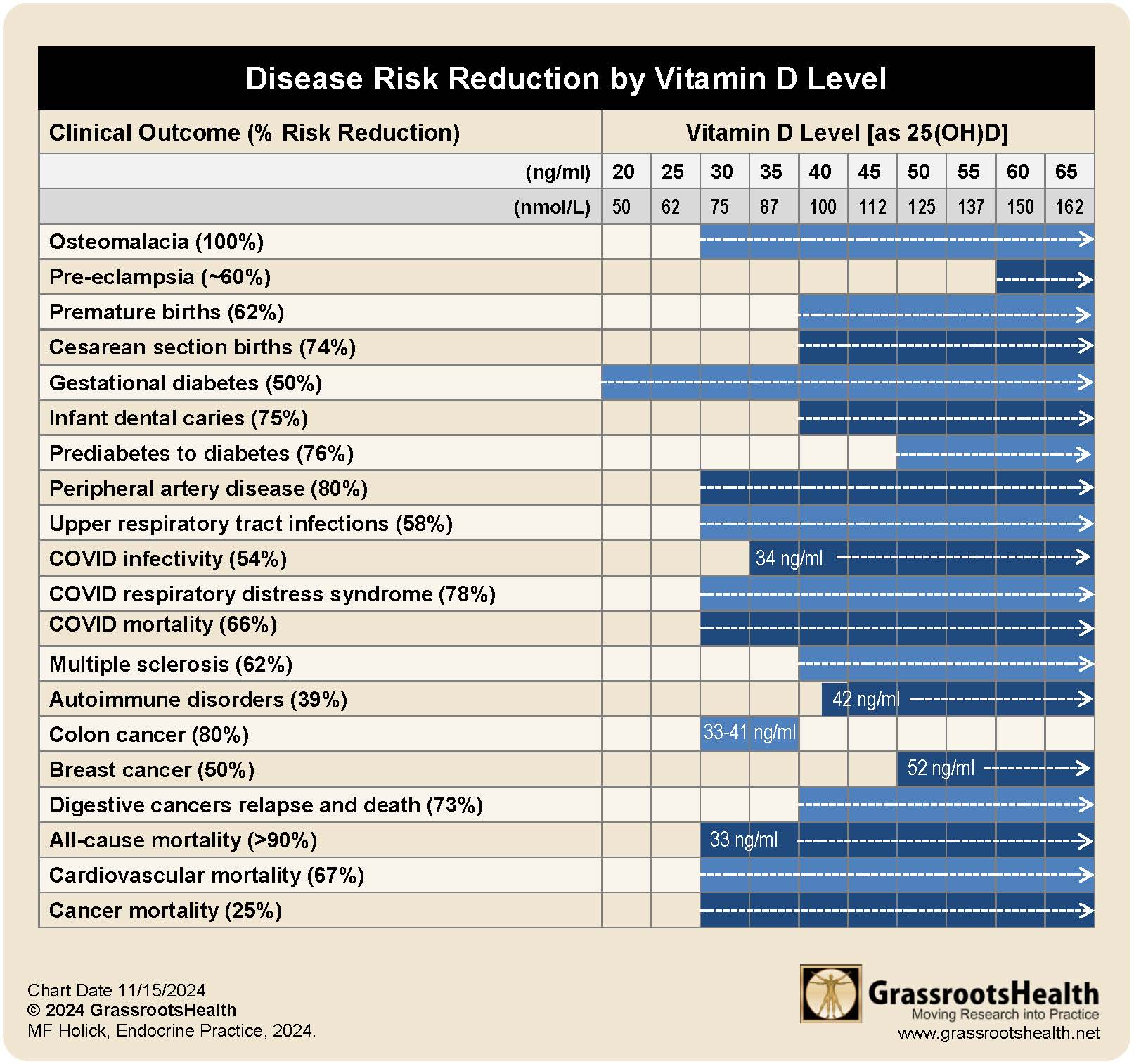
Dr. Holick’s review highlights that vitamin D plays a fundamental role in reducing the risk of numerous chronic diseases, including cardiovascular disease, autoimmune conditions, infections, and certain cancers, through its effects on immune regulation, inflammation, and cellular function. Similarly, Dr. Grant’s analyses, including large-scale ecological and observational studies, demonstrate a consistent inverse relationship between serum 25(OH)D levels and disease incidence, showing lower risk across multiple major health outcomes associated with differing optimal vitamin D serum level targets.
Overall, this research shows that optimal vitamin D levels differ by health outcome, with many chronic diseases requiring levels in the range of 50–60 ng/mL or higher to achieve maximal benefit. In this context, higher serum 25(OH)D concentrations are not only beneficial but may be necessary to reduce the burden of many of today’s most common chronic diseases.
Autoimmunity, Mortality, and Higher Targets
When it comes to more complex conditions such as autoimmune diseases, the research suggests that even higher vitamin D levels may be required for a therapeutic effect.
A systematic review by Dr. Sunil Wimalawansa on vitamin D, infections, and autoimmunity reports that suppressing autoimmune activity and improving all-cause mortality may require maintaining substantially higher serum 25(OH)D concentrations, often achieved through carefully supervised higher-dose protocols. Additional insights from GrassrootsHealth highlight the growing use of vitamin D in therapeutic, pharmacological contexts, particularly in autoimmune conditions such as multiple sclerosis. Clinical approaches like the Coimbra Protocol utilize individualized, higher-dose vitamin D strategies paired with careful monitoring to address underlying immune dysregulation and vitamin D resistance. These therapeutic approaches are based on the understanding that vitamin D is not simply a nutrient, but a powerful regulator of immune function, influencing how immune cells respond, communicate, and maintain balance. In this context, vitamin D has been described as a key factor in “unlocking” the body’s biochemical defenses and restoring immune tolerance.
Together, these findings suggest that for certain individuals, particularly those with autoimmune conditions, standard target ranges may not be sufficient, and higher, personalized vitamin D levels may be necessary to achieve meaningful clinical benefit.
In Conclusion
Vitamin D is far more than a “bone vitamin.” It is a powerful regulator of immune function, inflammation, and cellular health. The evidence continues to show that aiming for higher, optimized levels, rather than simply avoiding deficiency, can have meaningful impacts on health outcomes. As the science evolves, so too should our perspective:
- Sufficiency is not the same as optimal
- Higher serum levels can be associated with greater health benefits
- Individual needs vary, particularly in the context of chronic disease, immune challenges, and genetic differences
Expanding the target range to 40–80 ng/mL may better capture the full spectrum of vitamin D’s benefits; supporting not only bone health, but also immune resilience, chronic disease prevention, and overall longevity. As always, the most effective approach is personalized:
Measure your level, optimize your intake, and retest to ensure you are reaching and maintaining your target range.
Are You Getting Enough Vitamin D for Your Health Concerns?
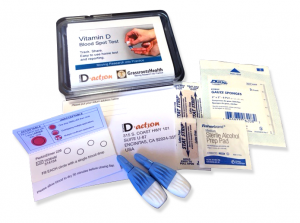 Having and maintaining healthy vitamin D levels and other nutrient levels can help improve your health now and for your future. Choose which additional nutrients to measure, such as your omega-3s and essential minerals including magnesium and zinc, by creating your custom home test kit today. Take steps to improve the status of each of these measurements to benefit your overall health. You can also track your own intakes, symptoms and results to see what works best for YOU.
Enroll and test your levels today, learn what steps to take to improve your status of vitamin D (see below) and other nutrients and blood markers, and take action! By enrolling in the GrassrootsHealth projects, you are not only contributing valuable information to everyone, you are also gaining knowledge about how you could improve your own health through measuring and tracking your nutrient status, and educating yourself on how to improve it.
How Can You Use this Information for YOUR Health?
Having and maintaining healthy vitamin D and other nutrient levels can help improve your health now and for your future. Measuring is the only way to make sure you are getting enough!
STEP 1 Order your at-home blood spot test kit to measure vitamin D and other nutrients of concern to you, such as omega-3s, magnesium, essential and toxic elements (zinc, copper, selenium, lead, cadmium, mercury); include hsCRP as a marker of inflammation or HbA1c for blood sugar health
STEP 2 Answer the online questionnaire as part of the GrassrootsHealth study
STEP 3 Using our educational materials and tools (such as our dose calculators), assess your results to determine if you are in your desired target range or if actions should be taken to get there
STEP 4 After 3-6 months of implementing your changes, re-test to see if you have achieved your target level(s)