

Published on December 18, 2025

Join us as Dr. Michael Holick reviews the latest research to show just how much vitamin D serum levels can affect the risk of many chronic diseases.
Key Points
- In a review article from last year (2024), Dr. Holick offers a well-rounded review of studies, including observational and association-type studies, and very clearly demonstrates the observed benefits of achieving and maintaining vitamin D levels higher than those recommended by the latest Endocrine Society vitamin D guidelines update
- Many diseases, including diabetes, respiratory diseases, infections, autoimmune diseases, and cancers, show a very clear and significant association with vitamin D – as vitamin D levels increase, risk decreases
- In his upcoming Vitamin D Study Hour, Dr. Holick will be focusing on these findings to help counter the confusion caused by these guidelines and provide practical uses of vitamin D for individuals and for clinical settings
 In a 2024 review titled “Revisiting Vitamin D Guidelines: A Critical Appraisal of the Literature,” Dr. Holick, who was chairman for the 2011 Endocrine Society’s Guidelines on Vitamin D, offers his perspective on the 2024 updated Endocrine Society Guidelines on Vitamin D.
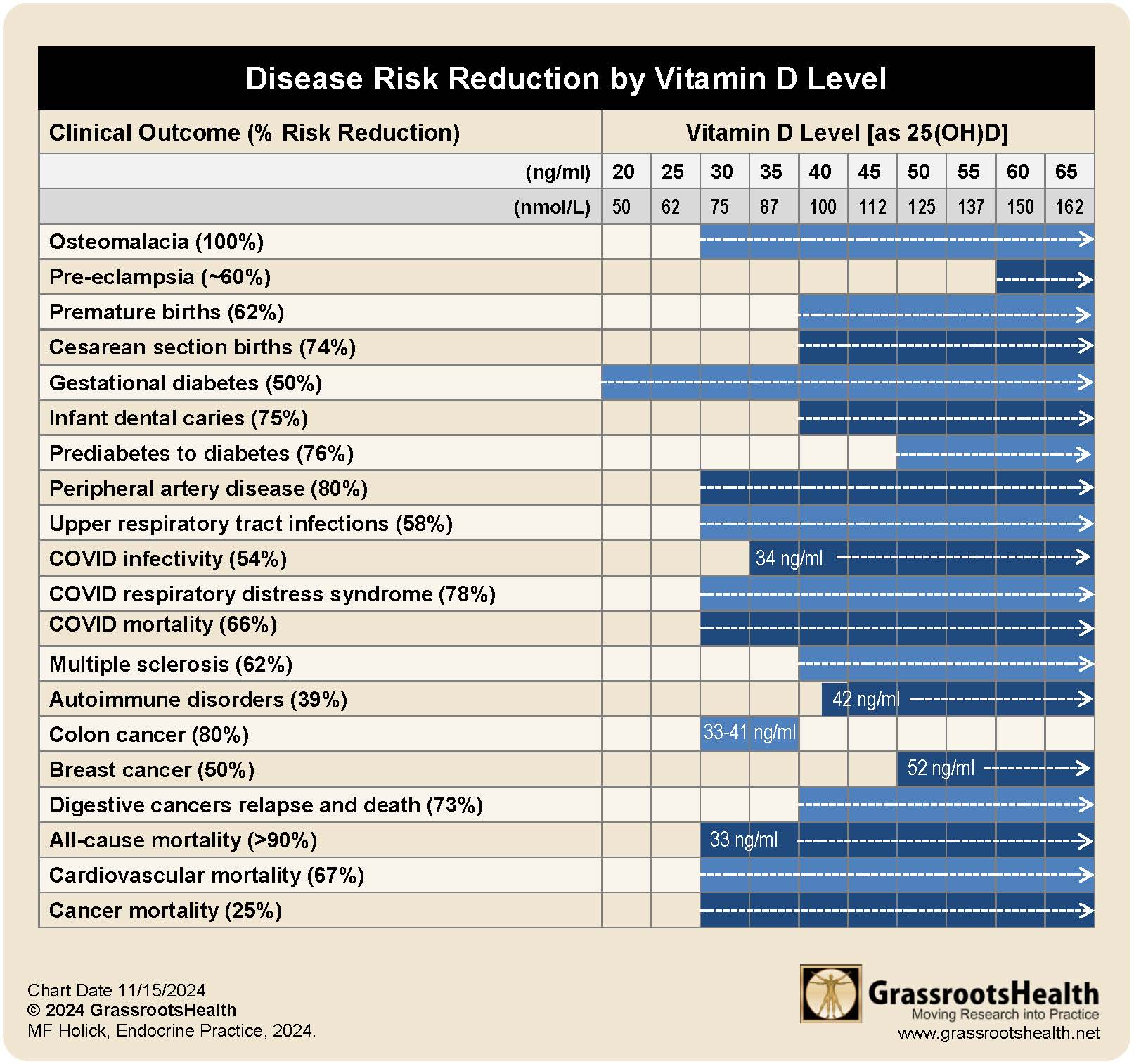
Although these updated guidelines relied heavily on data from randomized controlled trials (RCTs), there remains an important and irreplaceable role of observational and association studies, data which was ignored for these guidelines. Dr. Holick offers a well-rounded review of such studies and very clearly demonstrates the observed benefits of achieving and maintaining vitamin D levels of at least 30 ng/ml (75 nmol/L), optimally 50 ng/ml (125 nmol/L). Such findings are outlined in Table 1 from the paper, which are illustrated in the chart below showing decreased risk of various clinical outcomes based on achieved vitamin D level.
Several of these outcomes include:
- 100% reduction of osteomalacia with vitamin D levels of 30 ng/ml or above
- 62% reduction of premature births with vitamin D levels of 40 ng/ml or above
- 76% reduction of prediabetes to diabetes with vitamin D levels of 50 ng/ml or above
- 80% reduction of peripheral artery disease with vitamin D levels of 29.2 ng/ml or above
- 58% reduction of upper respiratory tract infections with vitamin D levels of 30 ng/ml or above
- more than 90% reduction of all cause mortality with vitamin D levels of 33 ng/ml or above
Just to name a few…
During our next Vitamin D Study Hour on Wednesday, January 7th, Dr. Holick will be presenting an informational, detailed, evidence driven presentation focusing on this paper and others, filled with research to support what optimal vitamin D levels should be for all ages and stages of life, and to lower the risk of many common health conditions.
“Revisiting Vitamin D Guidelines: A critical appraisal of the literature” by Dr. Michael Holick
Highlights of the Paper:
- Perspective of 2024 Endocrine Society’s Guidelines on Vitamin D compared to and contrasted to the 2011 Endocrine Society’s Guidelines
- Reviewed the 2024 Guidelines, Vitamin D for the Prevention of Disease: For public health and extra skeletal health
- Reviewed associations’, and other studies that support a serum concentration of 25-hydroxyvitamin D of at least 30 ng/ mL, for bone health and extra skeletal health benefits
- How much vitamin D is required to maintain a 25-hydroxyvitamin D in the preferred range of 40-60 ng/mL for maximum health.
Figure 4 is another excellent visual showing how
“Vitamin D deficiency increases risk for poor pregnancy outcomes, early childhood dental caries, increased risk for autoimmune disorders, increased risk for upper respiratory tract infections including COVID 19, advancement of prediabetes to type 2 diabetes, cardiovascular disease, neurocognitive dysfunction, mortality and accelerating mortality from deadly cancers.”

Register for the Study Hour & Learn More Here
How Are Your Levels of Vitamin D and Other Important Nutrients?
Check your vitamin D, omega-3s, magnesium, and other important markers today as part of the vitamin D*action project!
Measure your:
- Vitamin D
- Magnesium PLUS Elements (including zinc, copper, selenium, mercury, cadmium and lead)
- Omega-3 Fatty Acids
- hsCRP (for Inflammation)
- HbA1c (for Blood Sugar)
- and more
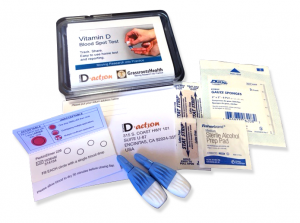
Did you know that each of the above can be measured at home using a simple blood spot test? As part of our ongoing research project, you can order your home blood spot test kit to get your levels, followed by education and steps to take to help you reach your optimal target levels. Start by enrolling and ordering your kit to measure each of the above important markers, and make sure you are getting enough of each to support better health and wellbeing!
Start Here to Measure Your Levels
How Can You Use this Information for YOUR Health?
Having and maintaining healthy vitamin D and other nutrient levels can help improve your health now and for your future. Measuring is the only way to make sure you are getting enough!
STEP 1 Order your at-home blood spot test kit to measure vitamin D and other nutrients of concern to you, such as omega-3s, magnesium, essential and toxic elements (zinc, copper, selenium, lead, cadmium, mercury); include hsCRP as a marker of inflammation or HbA1c for blood sugar health
STEP 2 Answer the online questionnaire as part of the GrassrootsHealth study
STEP 3 Using our educational materials and tools (such as our dose calculators), assess your results to determine if you are in your desired target range or if actions should be taken to get there
STEP 4 After 3-6 months of implementing your changes, re-test to see if you have achieved your target level(s)