

Published on August 13, 2025

Vitamin D Deficiency in the U.S.: Still a Widespread Problem for Our Health and the Cost of Healthcare (Part 2)
Key Points
- Vitamin D deficiency significantly increases healthcare costs – For example, German cohort data showed inpatient costs up to 226% higher for severely deficient individuals, and a Veterans Affairs study found costs 39% higher for deficient patients.
- Studies consistently report more frequent clinic and ER visits, longer hospital stays, and greater use of inpatient services among those with low vitamin D levels.
- Patients who corrected deficiency and had follow-up vitamin D testing saw up to 50% lower inpatient costs and fewer hospitalizations, ICU admissions, and ER visits.
- Addressing deficiency is highly cost-effective at a public health level, while also safely and effectively reducing risk for many leading causes of death.
 Even after decades of research and scientific evidence supporting the countless health benefits of vitamin D, it remains the number one nutrient deficiency in the world. Our health, our happiness, our time, and our wallets, are paying for it…
In Part 1 of this blog series, we reviewed the prevalence of vitamin D deficiency and insufficiency in the United States along with several factors that increase risk of deficiency. Nearly two-thirds of Americans have insufficient vitamin D levels, with 2.6% severely deficient, 22% moderately deficient, and 40.9% insufficient; only 34.5% are considered sufficient, and even fewer have optimal levels (40–60 ng/ml). Part 2 below covers the alarming costs of vitamin D deficiency, including increased hospitalizations and financial costs. We will follow up by outlining the health consequences of vitamin D deficiency for this and future generations.
What is the Financial Cost of Vitamin D Deficiency?
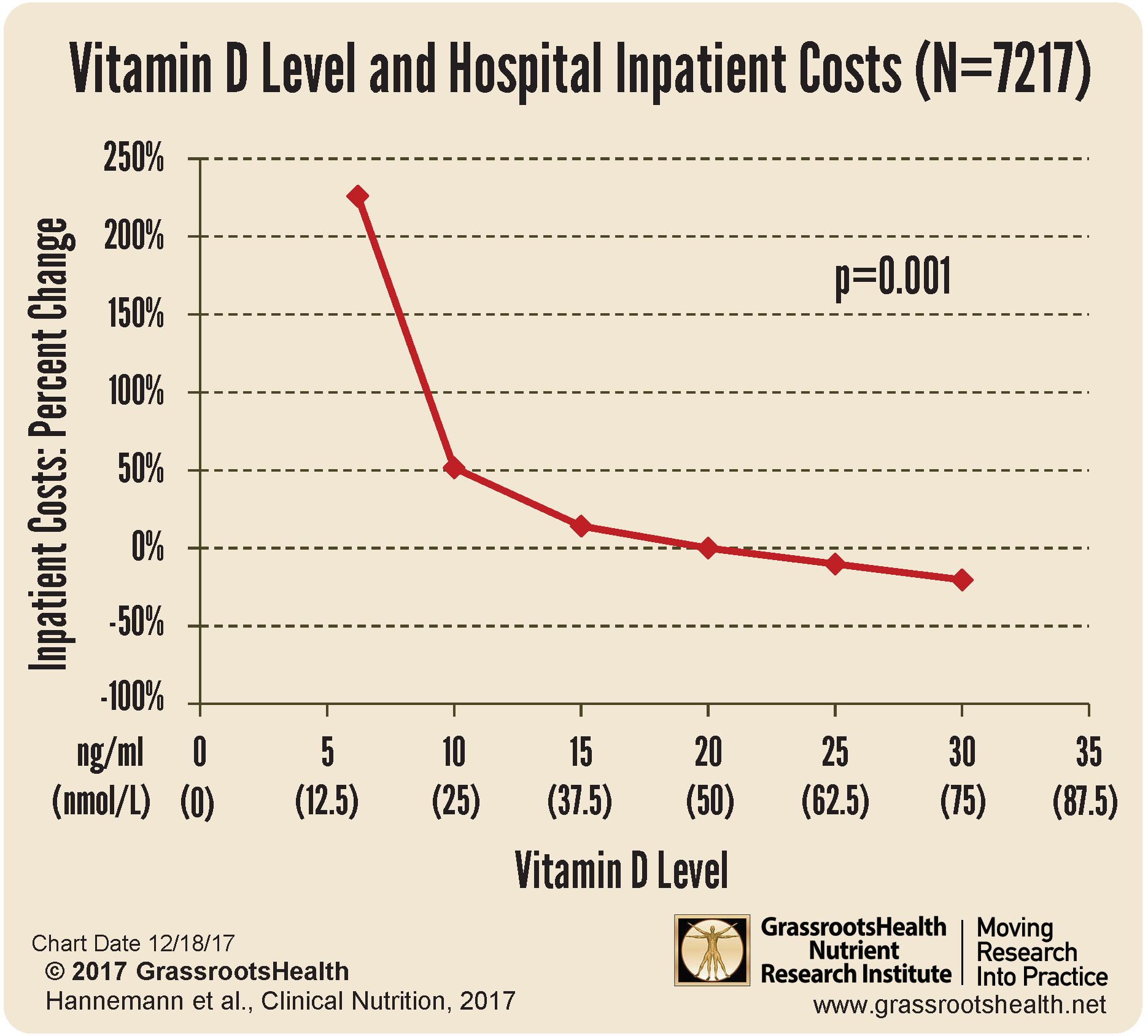
Several studies have evaluated the financial burden due to vitamin D deficiency. For example, a study by Hannemann et al., 2018 included data from two North-East German health cohorts, with records from over 7,000 patients. Vitamin D levels [as 25(OH)D] were grouped into the following categories:
- Severely deficient: less than 10 ng/ml
- Deficient: less than 20 ng/ml
- Sufficient: 20 ng/ml or higher
Keep in mind GrassrootsHealth scientists recommend 40-60 ng/ml (100-150 nmol/L), but these were the cut off points the researchers used for analysis. They found that
- Approximately 8% of the patients were severely deficient, 41% were deficient, and 51% were sufficient
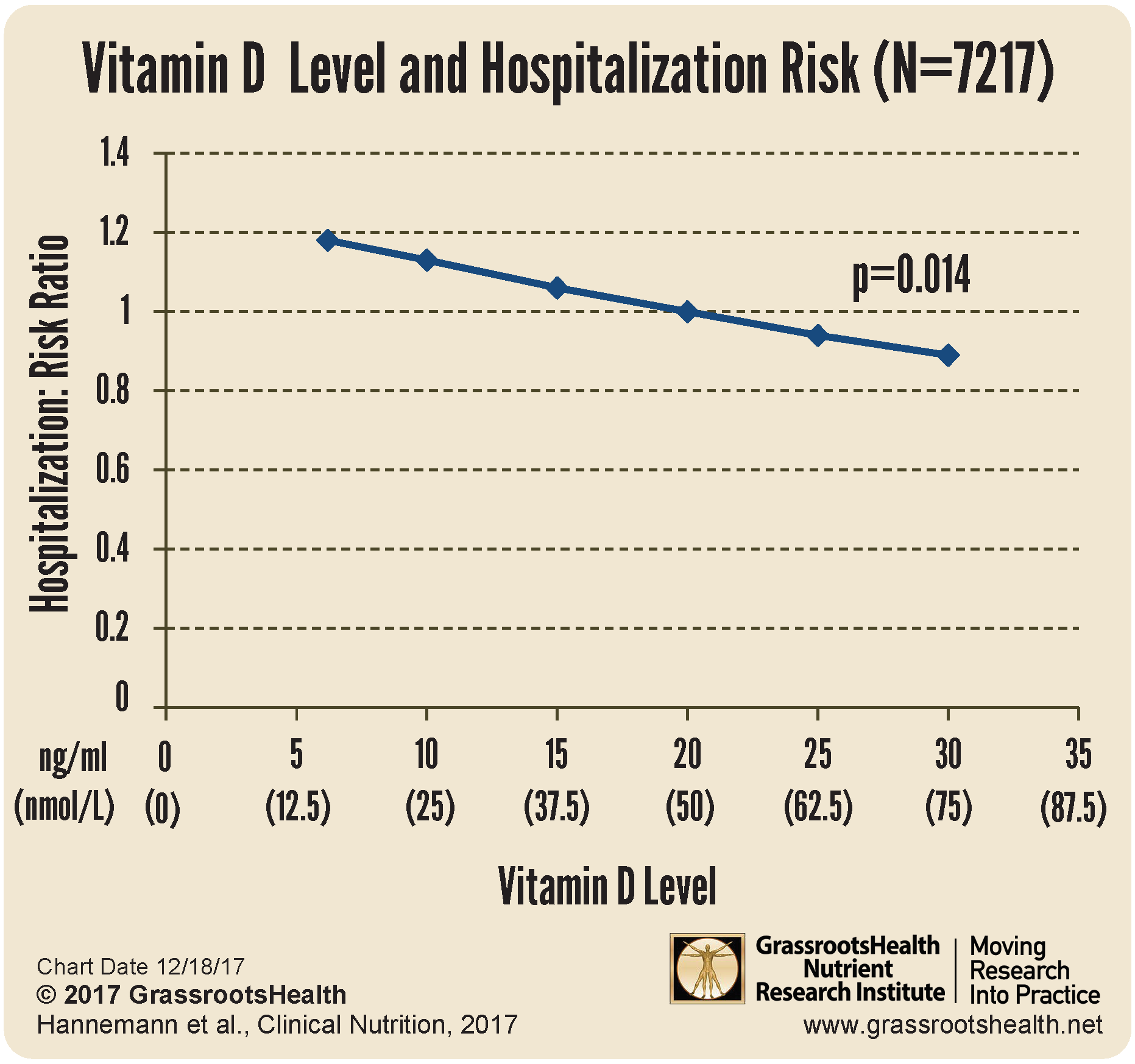
- There was a significant relationship between vitamin D levels and increased inpatient health care costs and hospitalizations
- Vitamin D levels of 5, 10 and 15 ng/ml had higher inpatient costs by 226.1%, 51.5% and 14.1%, respectively, compared those with levels of 20 ng/ml or higher
- Women dominated the severely deficient group, while the other groups were more evenly matched between men and women
A subset of data, with over 4,000 participants, adjusted for sex, age, month of blood sampling, years of schooling, unemployment, equivalent household income, type of insurance (private vs. statutory), and waist circumference found the following results:
Health Care Costs 39% Higher if Vitamin D Deficient, Veterans Study
A 2008 study reported a retrospective chart analysis in a Veterans Affairs (VA) Hospital in the Southeastern United States. The study found that overall healthcare costs were 39% higher in veterans with vitamin D deficiency, as defined in this study by levels <20 ng/ml (50 nmol/L). Patients with vitamin D deficiency were found to have:
- more frequent clinic visits
- more frequent ER visits
- increased inpatient stay and inpatient services
For those patients with vitamin D test results, roughly 30-50% were vitamin D deficient on their initial test. The VA center with the lowest percentage of vitamin D deficiency also had more than 50% lower inpatient costs than the three centers with the highest rates of vitamin D deficiency. Patients who received follow-up vitamin D testing had 50% lower inpatient laboratory and pharmacy costs, as compared to those who only received one test (which gives the patient data required to maintain their optimal vitamin D level).
They compared patients who were (1) both deficient and never had a follow-up test, with (2) those who were only deficient or had no follow-up test, and (3) those who were both sufficient and had at least one follow-up test. The first group had 70% higher total inpatient costs than the second group, and almost 300% higher costs than the third group. Because of this finding, the study authors proposed that as a standard practice, vitamin D levels should be checked once or twice a year until they are stable at the desired level.
Vitamin D Can Also Save You Time and Stress
 A clinical trial by LaRiccia et al., 2023 adds to the growing body of evidence linking adequate vitamin D levels to better health outcomes and reduced strain on the healthcare system.
In this pragmatic randomized trial, healthcare workers at an East Coast inner-city hospital were either given 5000 IU of vitamin D3 daily for roughly nine months or placed in a non-supplemented control group. Researchers tracked healthcare costs and usage through the hospital’s employee insurance claims over a 10.9-month observation period.
While cost differences between groups were not statistically significant—likely due to the study’s modest size—healthcare utilization told a clearer story. Compared to controls, the vitamin D group had:
- 19% fewer hospitalizations for any reason
- Fewer ICU admissions (−0.06 per 1000 person-days)
- Fewer emergency room visits (−0.26 per 1000 person-days)
- Fewer hospitalizations due to COVID-19
These reductions were statistically significant and align with the previous observational studies in U.S. veterans, community hospitals, and German population cohorts showing that low vitamin D status is linked to greater healthcare usage and costs.
Another study among ICU patients by Matthews et al, 2012 found that
- Intensive care patients were at much greater risk of vitamin D deficiency
- 53.5% had severe vitamin D deficiency, 37.2% had moderate deficiency, 7.0% had mild deficiency, and only 1.2% had normal vitamin D levels
- Length of ICU stay, treatment cost, and mortality were significantly related to vitamin D levels
And a study by Youssef et al., 2010 found that
- Vitamin D deficient patients who had C. difficile or staphylococcal infections incurred costs more than five times higher than non-deficient patients
- Vitamin D deficient patients had a four times greater total length of hospital stay and the total number of hospitalizations was also significantly greater
Vitamin D Researchers Agree: Addressing Vitamin D Deficiency is Cost-Effective, Preserving Healthcare Resources and Saving Lives
One of the many topics vitamin D scientists discussed in Baggerly et al. (2015) was the cost-effectiveness of addressing vitamin D deficiency in public health, estimating a reduction of direct costs in healthcare to be roughly $130 billion annually.
“Of the 30 leading causes of death reported in the United States in 2010, 19 are linked to low vitamin D status…”
Do you want to lower your healthcare costs and risk of hospitalization? Take steps for your own health to ensure optimal vitamin D levels – for your family and loved ones as well – by measuring today.
Order Your Vitamin D Test Kit Here
Measure Your Vitamin D Level from Home
If you haven’t had your vitamin D levels checked recently, now is the time! With so many Americans still falling short, awareness is the first step toward change.
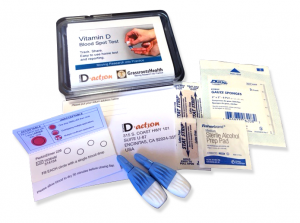
Measuring your vitamin D level and calculating a supplementation amount to help reach and maintain a target level, or taking loading doses to correct deficiency faster, could possibly make all the difference in overall health, wellbeing, and how a current disease situation progresses. Test your level now!
Create your custom home blood spot kit by adding any of the following measurements, along with your vitamin D:
- Omega-3 Index (with or without Ratios AA:EPA and Omega-6:Omega-3)
- Magnesium (with additional Elements copper, zinc, selenium, mercury, and cadmium)
- hsCRP as a marker of inflammation and HbA1c as a marker of blood sugar health
Having and maintaining healthy vitamin D levels and other nutrient levels can help improve your health, now and for the future.
How Can You Use this Information for YOUR Health?
Having and maintaining healthy vitamin D and other nutrient levels can help improve your health now and for your future. Measuring is the only way to make sure you are getting enough!
STEP 1 Order your at-home blood spot test kit to measure vitamin D and other nutrients of concern to you, such as omega-3s, magnesium, essential and toxic elements (zinc, copper, selenium, lead, cadmium, mercury); include hsCRP as a marker of inflammation or HbA1c for blood sugar health
STEP 2 Answer the online questionnaire as part of the GrassrootsHealth study
STEP 3 Using our educational materials and tools (such as our dose calculators), assess your results to determine if you are in your desired target range or if actions should be taken to get there
STEP 4 After 3-6 months of implementing your changes, re-test to see if you have achieved your target level(s)