

by Richard Z. Cheng, M.D., Ph.D.
Editor-in-Chief, Orthomolecular Medicine News Service
Key Points
- Vitamin D levels don’t always rise as expected because individual biology is complex.
- Genetics, inflammation, gut health, stress, and nutrient cofactors all affect how the body produces and uses vitamin D.
- Even if blood levels appear normal, vitamin D may not function properly without cofactors like magnesium, vitamin K2, zinc, and omega‑3s.
- Optimal vitamin D levels (~40–80 ng/mL) support immunity, bone health, and overall wellness; toxicity is rare.
- People respond differently to the same dose, making personalized approaches far more effective than standard dosing.
- Orthomolecular medicine focuses on the whole system rather than isolated supplementation, ensuring vitamin D works where it matters most.
Measure Your Levels of Vitamin D & Other Important Health Markers
 Millions of people take Vitamin D or spend time in the sun, yet their blood Vitamin D levels barely improve. Others supplement modestly and reach optimal levels quickly.
This long-standing clinical puzzle is finally gaining scientific clarity.
A major 2025 Nature Communications study [1] identified over 160 genetic variants that affect Vitamin D status. Combined with research on micronutrient cofactors, metabolic health, and inflammation, the evidence points to a key conclusion:
Vitamin D deficiency is rarely a “single-nutrient problem.” It is a systems-biology problem.
Orthomolecular Medicine offers a complete solution.
1. Genetics Explains Why People Respond So Differently
Shraim et al. (Nature Communications, 2025) [1] found 162 variants affecting:
- UVB → Vitamin D production in skin
- Liver conversion (25-hydroxylase)
- Kidney conversion (1α-hydroxylase)
- Vitamin D binding protein
- Vitamin D receptor (VDR) sensitivity
Implications:
- Two individuals taking the same dose can have vastly different blood levels.
- Some people require higher intake to reach physiological levels.
- Genetics sets the baseline – but genes alone do not determine outcomes.
Genetics sets the baseline – but genes are not the full story.
See Figure 1 for visualization of the wide genetic variability in Vitamin D response.
Figure 1. Genetic Diversity in Vitamin D Response
This figure illustrates why two people taking the same supplement dose may show very different 25(OH)D levels-including one rising rapidly and the other barely changing. The 162 identified gene variants affect Vitamin D production in the skin, activation in liver/kidney, transport proteins, and receptor sensitivity (data from [1]).
2. “Vitamin D Resistance”: The Missing Diagnosis
In my 2024 OMNS review, I proposed that many individuals exhibit acquired Vitamin D resistance [2]:
Vitamin D is present, but cannot activate or function properly.
Drivers include:
- Chronic inflammation
- High cortisol and chronic stress
- Circadian disruption
- Fatty liver and insulin resistance
- Leaky gut & dysbiosis
- Environmental toxins
- Cofactor deficiencies (Mg, C, K2, B vitamins, Zn, Se)
This explains why many people experience:
“Vitamin D doesn’t work for me.”
The problem is not the Vitamin D – it is the internal metabolic environment.
3. Vitamin D Needs Its Team: The Essential Cofactors
Vitamin D metabolism and receptor activity depend on:
- Magnesium – enzymatic activation
- Vitamin K2 – directs calcium into bone
- Vitamin C – modulates inflammation & steroid hormone pathways
- B Vitamins – methylation & energy metabolism
- Zinc + Selenium – antioxidant & immune regulation
- Omega-3s – membrane function & inflammation balance
Without these cofactors, functional Vitamin D deficiency develops – even with “normal” blood levels.
General Cofactor Ranges
(Individual needs vary, but the following ranges apply to most adults.)
- Magnesium: 200-400 mg/day
- Vitamin K2 MK-7: 90-200 mcg/day
- Vitamin C: 1,000-3,000 mg/day
- Zinc: 15-30 mg/day
- Selenium: 100-200 mcg/day
- Omega-3s (EPA+DHA): 1-2 g/day
This is a core principle of Orthomolecular Medicine.
4. How Much Vitamin D Is Safe? The Evidence Is Clear
The overall benefit curve of serum 25(OH)D – how health outcomes improve up to the 60-80 ng/mL range – is shown in Figure 2.
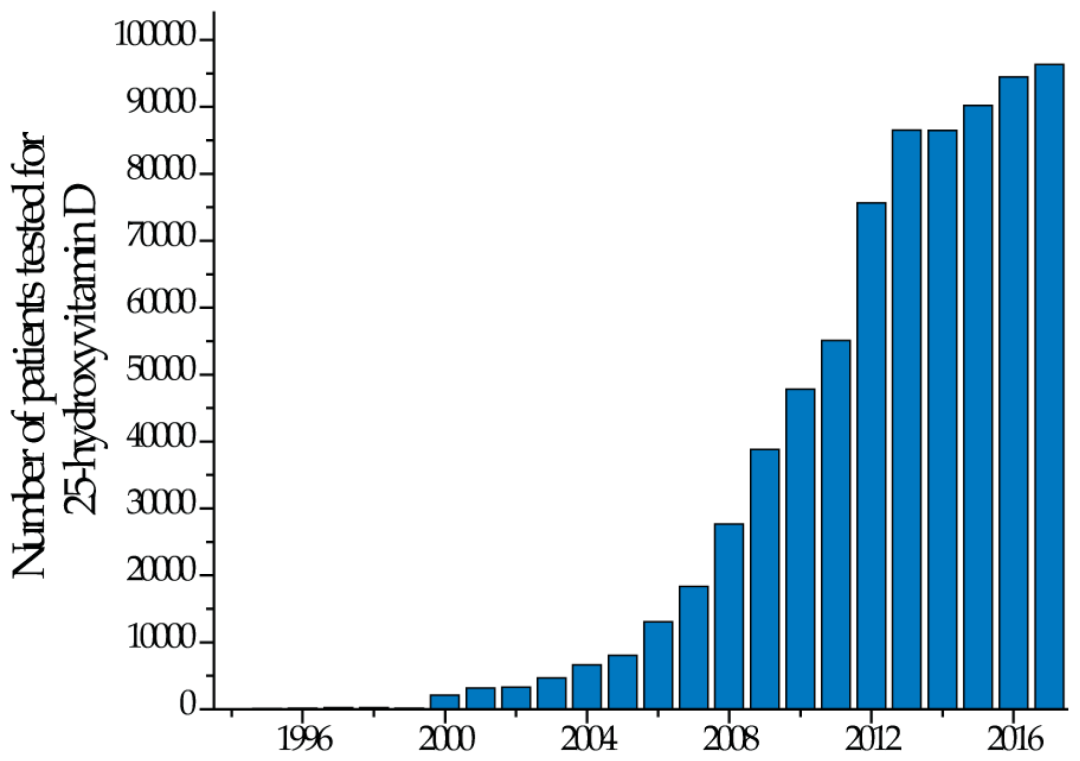
Figure 2. Vitamin D Benefit Curve
This chart shows the rapid rise in health benefits (immunity, metabolic function, bone health, mortality reduction) as serum 25(OH)D increases from 10 → 40 ng/mL, with a plateau around 60-80 ng/mL-the optimal physiological range (data from [3-12] ).
Optimal Range
- 40-80 ng/mL (100-200 nmol/L)
Safety Profile
- VITAL (2,000 IU/day) and ViDA (monthly 100,000 IU) trials:
- No increase in hypercalcemia
- No increase in kidney stones
- Toxicity rare below 150 ng/mL
- Real toxicity occurs only >200 ng/mL
Vitamin D remains one of the safest nutrients in modern medicine.
See Figure 3 for the Vitamin D toxicity curve and documented hypercalcemia thresholds.
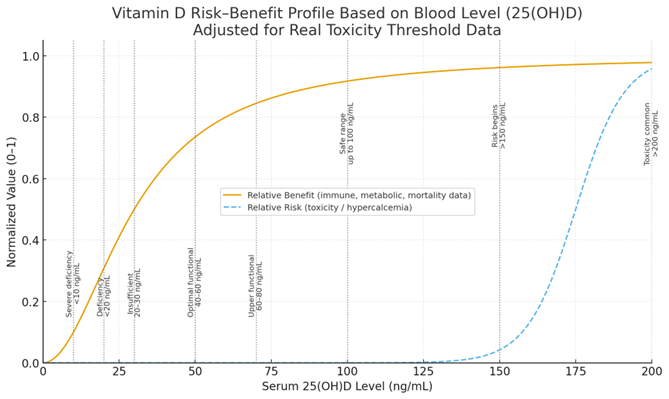
Figure 3. Vitamin D Safety Curve
This figure shows that real toxicity is extremely rare below 150 ng/mL, and documented toxicity occurs only when blood levels exceed 200 ng/mL, typically from accidental massive overdosing (data from [3-12].
5. A Real-World Case: When Higher Doses Are Necessary
Case 1: Husband-Wife GrassrootsHealth Cohort
A woman maintained 40-60 ng/mL on 2,000 IU/day.
Her husband, a Type 2 diabetic, taking the same amount:
- Could not surpass 20 ng/mL
- Needed 10× her dose to reach 30-40 ng/mL
Lesson: metabolic inflammation and genetics radically alter dose requirements.
Some individuals – particularly those with inflammation, obesity, or genetic variations – simply require higher doses.
Case 2: High-Dose Individual
A man in his 60s took 30,000 IU/day for 30 days.
Follow-up:
- 25(OH)D = 118 ng/mL
- No hypercalcemia
- Clinical improvements noted
This is within the low-risk / high-benefit zone repeatedly documented in large cohorts.
Case 3: Severe Hypercalcemia and Renal Impairment Induced by Prolonged High-Dose Vitamin D3 Supplementation
A 23-year-old previously healthy male had been taking high-dose vitamin D3 (50,000 IU daily) for several consecutive months, along with a multivitamin supplement containing calcium. He subsequently developed biochemical evidence of severe vitamin D intoxication. He was then referred to me.
- Serum 25(OH)D3 > 200 ng/mL (markedly elevated)
- Serum calcium 4.0 mmol/L (severe hypercalcemia)
- Parathyroid hormone suppressed to 8.63 pg/mL (PTH suppression consistent with vitamin D toxicity)
- Serum creatinine increased to 202 µmol/L
- eGFR decreased to 39 mL/min/1.73 m² (acute kidney injury)
This case illustrates the potential dangers of unsupervised high-dose vitamin D supplementation, especially when combined with exogenous calcium, leading to life-threatening hypercalcemia and renal impairment.
6. Lifestyle & Endocrine Factors Are Integral
Vitamin D status is influenced by:
- Sunlight & circadian rhythm
- Physical activity
- Cortisol & stress
- Liver & kidney function
- Microbiome health
- Toxic load
- Other micronutrients sufficiency
These factors align with the Orthomolecular view that nutrients do not work alone – they function within the body’s entire biochemical network.
7. Practical Orthomolecular Recommendations
1. Test Beyond 25(OH)D
- Include PTH, calcium, phosphorus, magnesium, CRP, liver markers.
2. Individualize the dose
Typical effective ranges:
- 5,000 IU/day
- 10,000 IU/day
- Short-term high-dose therapy for resistant cases
3. Always include cofactors
- Magnesium, K2, C, zinc, selenium.
4. Improve lifestyle factors
- Sunlight, gut repair, detoxification, stress reduction.
5. Recheck levels every 3-6 months
Conclusion
Vitamin D is not simply “take a pill and your level rises.”
It reflects a complex integration of:
Genes × Sunlight × Micronutrients × Metabolism × Inflammation × Endocrine Health = Necessity of a Personalized Dose
Orthomolecular Medicine restores the entire biochemical terrain – enabling Vitamin D to function as intended.
8. This Is One More Example of the Root-Cause Model of Chronic Disease
Vitamin D resistance is not an isolated phenomenon.
It exemplifies a deeper truth:
Chronic diseases arise from disruptions across multiple root drivers – genetic, metabolic, inflammatory, toxic, nutritional, and endocrine.
As I detailed in:
Cheng, R. Z. From Mutation to Metabolism: Root Cause Analysis of Cancer’s Initiating Drivers [13].
Health and disease are determined not by a single molecule (like vitamin C or D) or a single mechanism (like mitochondrial dysfunction or gut dysbiosis), but by the interconnected matrix of:
- Environmental toxin exposures
- Chronic infections
- Micronutrients
- Cellular metabolism
- Oxidative stress
- Mitochondrial function
- Hormonal regulation
- Immune resilience
Vitamin D resistance is simply one more illustration of this unifying principle:
To restore health, we must identify and correct as many root drivers as possible – not chase downstream symptoms or the mechanism between root drivers and clinical diseases.
Orthomolecular Medicine is the framework that recognizes and addresses these root drivers systematically.
About the Author
 Richard Z. Cheng, M.D., Ph.D. – Editor-in-Chief, Orthomolecular Medicine News Service
Dr. Cheng is a U.S.-based, NIH-trained, board-certified physician specializing in integrative cancer therapy, orthomolecular medicine, functional & anti-aging medicine. He maintains active practices in both the United States and China.
A Fellow of the American Academy of Anti-Aging Medicine and a Hall of Fame inductee of the International Society for Orthomolecular Medicine, Dr. Cheng is a leading advocate for nutrition-based, root-cause health strategies. He also serves as an expert reviewer for the South Carolina Board of Medical Examiners, and co-founded both the China Low Carb Medicine Alliance and the Society of International Metabolic Oncology.
Dr. Cheng offers online Integrative Orthomolecular Medicine consultation services.
📰 Follow his latest insights on Substack: https://substack.com/@rzchengmd
Measure Your Levels Today – Save 15% with Code OMEGA3S

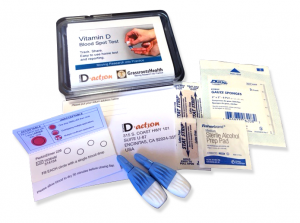
Create your custom home blood spot kit to help determine if you are getting enough of the following nutrients shown to benefit overall health, along with other measures, including:
 Vitamin D
- Omega-3 Index plus Omega-3:Omega-6 and AA:EPA Ratios
- Magnesium (plus Zinc, Copper, Selenium, Lead, Cadmium & Mercury)
- hsCRP
- HbA1c
- Type 1 Diabetes Autoantibodies
- TSH
 Vitamin D
Enroll and test your levels today, learn what steps to take to improve your status of omega-3s, vitamin D and other nutrients and blood markers, and take action! By enrolling in the GrassrootsHealth projects, you are not only contributing valuable information to everyone, you are also gaining knowledge about how you could improve your own health through measuring and tracking your nutrient status, and educating yourself on how to improve it.
Enroll in D*action and Test Your Levels Today!
By Richard Z. Cheng, M.D., Ph.D. Editor-in-Chief
References
1. Concato, J.; Shah, N.; Horwitz, R.I. Randomized, Controlled Trials, Observational Studies, and the Hierarchy of Research Designs. N Engl J Med 2000, 342, 1887-1892, doi: 10.1056/NEJM200006223422507.
2. Bothwell, L.E.; Podolsky, S.H. The Emergence of the Randomized, Controlled Trial. N Engl J Med 2016, 375, 501-504, doi: 10.1056/NEJMp1604635.
3. Light, D.W.; Lexchin, J.R. Pharmaceutical Research and Development: What Do We Get for All That Money? BMJ 2012, 345, e4348, doi: 10.1136/bmj.e4348.
4. Angell, M. The Truth About the Drug Companies | Random House Publishing Group. https://www.penguinrandomhouse.com/books/3901/the-truth-about-the-drug-companies-by-marcia-angell-md/
5. Joyner, M.J.; Paneth, N. Seven Questions for Personalized Medicine. JAMA 2015, 314, 999-1000, doi: 10.1001/jama.2015.7725.
6. Rothwell, P.M. External Validity of Randomised Controlled Trials: “To Whom Do the Results of This Trial Apply?” Lancet 2005, 365, 82-93, doi: 10.1016/S0140-6736(04)17670-8.
7. Wasserstein, R.L.; Lazar, N.A. The ASA Statement on P-Values: Context, Process, and Purpose. The American Statistician 2016.
8. Hallberg, S.J.; McKenzie, A.L.; Williams, P.T.; Bhanpuri, N.H.; Peters, A.L.; Campbell, W.W.; Hazbun, T.L.; Volk, B.M.; McCarter, J.P.; Phinney, S.D.; et al. Effectiveness and Safety of a Novel Care Model for the Management of Type 2 Diabetes at 1 Year: An Open-Label, Non-Randomized, Controlled Study. Diabetes Ther 2018, 9, 583-612, doi: 10.1007/s13300-018-0373-9.
9. Riordan, H.D.; Hunninghake, R.B.; Riordan, N.H.; Jackson, J.J.; Meng, X.; Taylor, P.; Casciari, J.J.; González, M.J.; Miranda-Massari, J.R.; Mora, E.M.; et al. Intravenous Ascorbic Acid: Protocol for Its Application and Use. P R Health Sci J 2003, 22, 287-290. https://riordanclinic.org/wp-content/uploads/2014/12/89022715.pdf
10. Ioannidis, J.P.A. Why Most Published Research Findings Are False. PLoS Med 2005, 2, e124, doi: 10.1371/journal.pmed.0020124.
11. Pearl, J.; Mackenzie, D. The Book of Why: The New Science of Cause and Effect. Science 2018, doi: 10.1126/science.aau9731.
12. Hernan, M.A.; Robins, J.M. Causal Inference: What If; CRC Press: Boca Raton, 2025; ISBN 978-1-315-37493-2.
13. Deaton, A.; Cartwright, N. Understanding and Misunderstanding Randomized Controlled Trials. Soc Sci Med 2018, 210, 2-21, doi: .
14. Gøtzsche, P.C. Deadly Medicines and Organised Crime : How Big Pharma Has Corrupted Healthcare; London, United Kingdom : Radcliffe Publishing, 2013; ISBN 978-1-84619-884-7.
15. Lexchin, J. Those Who Have the Gold Make the Evidence: How the Pharmaceutical Industry Biases the Outcomes of Clinical Trials of Medications. Sci Eng Ethics 2012, 18, 247-261, doi: 10.1007/s11948-011-9265-3.
16. Greenhalgh, T.; Howick, J.; Maskrey, N.; Evidence Based Medicine Renaissance Group Evidence Based Medicine: A Movement in Crisis? BMJ 2014, 348, g3725, doi: 10.1136/bmj.g3725.
17. Cheng, R. Hospital Treatment of Serious and Critical COVID-19 Infection with High-Dose Vitamin C | Cheng Integrative Health Center Blog Available online: http://www.drwlc.com/blog/2020/03/18/hospital-treatment-of-serious-and-critical-covid-19-infection-with-high-dose-vitamin-c/ (accessed on 3 August 2020).
18. Cheng, Richard Z Can Early and High Intravenous Dose of Vitamin C Prevent and Treat Coronavirus Disease 2019 (COVID-19)? Medicine in Drug Discovery 2020, 5, 100028, doi: 10.1016/j.medidd.2020.100028.
19. Cheng, R.Z. From Mutation to Metabolism: Root Cause Analysis of Cancer’s Initiating Drivers 2025. https://www.preprints.org/manuscript/202509.0903
20. Evans, P.; Halliwell, B. Micronutrients: Oxidant/Antioxidant Status. Br J Nutr 2001, 85 Suppl 2, S67-74. PMID: 11509092
21. Vertuani, S.; Angusti, A.; Manfredini, S. The Antioxidants and Pro-Antioxidants Network: An Overview. Curr Pharm Des 2004, 10, 1677-1694, doi: 10.2174/1381612043384655.
22. Gombart, A.F.; Pierre, A.; Maggini, S. A Review of Micronutrients and the Immune System-Working in Harmony to Reduce the Risk of Infection. Nutrients 2020, 12, 236, doi: 10.3390/nu12010236.
23. Name, J.J.; Souza, A.C.R.; Vasconcelos, A.R.; Prado, P.S.; Pereira, C.P.M. Zinc, Vitamin D and Vitamin C: Perspectives for COVID-19 With a Focus on Physical Tissue Barrier Integrity. Front Nutr 2020, 7, 606398, doi: 10.3389/fnut.2020.606398.
24. Oudemans-van Straaten, H.M.; Spoelstra-de Man, A.M.; de Waard, M.C. Vitamin C Revisited. Crit Care 2014, 18, 460, doi: 10.1186/s13054-014-0460-x.
25. Cheng, R.Z. A Hallmark of Covid-19: Cytokine Storm/Oxidative Stress and Its Integrative Mechanism. Orthomolecular Medicine News Service 2022, 18(3). https://orthomolecular.org/resources/omns/v18n03.shtml
26. Fowler, A.A.; Truwit, J.D.; Hite, R.D.; Morris, P.E.; DeWilde, C.; Priday, A.; Fisher, B.; Thacker, L.R.; Natarajan, R.; Brophy, D.F.; et al. Effect of Vitamin C Infusion on Organ Failure and Biomarkers of Inflammation and Vascular Injury in Patients With Sepsis and Severe Acute Respiratory Failure: The CITRIS-ALI Randomized Clinical Trial. JAMA 2019, 322, 1261-1270, doi: 10.1001/jama.2019.11825.
27. NCI, N. Intravenous Vitamin C (PDQ(r)) – NCI Available online: https://www.cancer.gov/about-cancer/treatment/cam/hp/vitamin-c-pdq (accessed on 11 October 2025).
28. Grant, W.B.; Boucher, B.J.; Bhattoa, H.P.; Lahore, H. Why Vitamin D Clinical Trials Should Be Based on 25-Hydroxyvitamin D Concentrations. J Steroid Biochem Mol Biol 2018, 177, 266-269, doi: 10.1016/j.jsbmb.2017.08.009.
29. Grant, W.B. Using Findings from Observational Studies to Guide Vitamin D Randomized Controlled Trials. J Intern Med 2015, 277, 83-86, doi: 10.1111/joim.12260.
30. Grant, W.B. The Latest Evidence from Vitamin D Intervention Trials for Non-Skeletal Outcomes. Calcif Tissue Int 2020, 106, 574-575, doi: 10.1007/s00223-020-00667-6.
31. Grant, W.B.; Boucher, B.J.; Al Anouti, F.; Pilz, S. Comparing the Evidence from Observational Studies and Randomized Controlled Trials for Nonskeletal Health Effects of Vitamin D. Nutrients 2022, 14, 3811, doi: 10.3390/nu14183811.
32. Holick, M.F. Revisiting Vitamin D Guidelines: A Critical Appraisal of the Literature. Endocr Pract 2024, 30, 1227-1241, doi: 10.1016/j.eprac.2024.10.011.
33. Grant, W.B.; Wimalawansa, S.J.; Pludowski, P.; Cheng, R.Z. Vitamin D: Evidence-Based Health Benefits and Recommendations for Population Guidelines. Nutrients 2025, 17, 277, doi: 10.3390/nu17020277.
34. Holick, M.F. The Vitamin D Deficiency Pandemic and Consequences for Nonskeletal Health: Mechanisms of Action. Mol Aspects Med 2008, 29, 361-368, doi: 10.1016/j.mam.2008.08.008.
35. Ramagopalan, S.V.; Heger, A.; Berlanga, A.J.; Maugeri, N.J.; Lincoln, M.R.; Burrell, A.; Handunnetthi, L.; Handel, A.E.; Disanto, G.; Orton, S.-M.; et al. A ChIP-Seq Defined Genome-Wide Map of Vitamin D Receptor Binding: Associations with Disease and Evolution. Genome Res 2010, 20, 1352-1360, doi: 10.1101/gr.107920.110.
36. Grant, W.B.; Boucher, B.J.; Cheng, R.Z.; Pludowski, P.; Wimalawansa, S.J. Vitamin D and Cardiovascular Health: A Narrative Review of Risk Reduction Evidence. Nutrients 2025, 17, 2102, doi: 10.3390/nu17132102.
37. Jamilian, A.; Ghalichi, F.; Hamedi Kalajahi, F.; Radkhah, N.; Jourabchi, N.; Musazadeh, V.; Amini-Salehi, E.; Zarezadeh, M.; Ostadrahimi, A. The Role of Vitamin D in Outcomes of Critical Care in COVID-19 Patients: Evidence from an Umbrella Meta-Analysis of Interventional and Observational Studies. Public Health Nutr 2024, 27, e127, doi: 10.1017/S1368980024000934.
38. Yang, J.-M.; Li, Z.-Q.; Zhong, Y.-B.; Xie, H.-Y.; Luo, Y.; Xiao, L.; Liao, J.-H.; Wang, M.-Y. Association Between Vitamin D and COVID-19-Related Outcomes: An Umbrella Review of Meta-Analyses. Nutr Rev 2025, 83, 1757-1770, doi: 10.1093/nutrit/nuae225.
39. Petrelli, F.; Oldani, S.; Borgonovo, K.; Cabiddu, M.; Dognini, G.; Ghilardi, M.; Parati, M.C.; Petro’, D.; Dottorini, L.; Rea, C.; et al. Vitamin D3 and COVID-19 Outcomes: An Umbrella Review of Systematic Reviews and Meta-Analyses. Antioxidants (Basel) 2023, 12, 247, doi: 10.3390/antiox12020247.
40. Kow, C.S.; Ramachandram, D.S.; Hasan, S.S.; Wong, Z.; Thiruchelvam, K. The Impact of Vitamin D Administration on Mortality in COVID-19 Patients: A Systematic Review and Meta-Analysis of Randomized Controlled Trials. Inflammopharmacology 2024, 32, 3205-3212, doi: 10.1007/s10787-024-01564-2.
41. Hosseini, B.; El Abd, A.; Ducharme, F.M. Effects of Vitamin D Supplementation on COVID-19 Related Outcomes: A Systematic Review and Meta-Analysis. Nutrients 2022, 14, 2134, doi: 10.3390/nu14102134.
42. Lahore, H. 19 of the Reasons That Vitamin D Trials Fail. Science-based Vitamin D 2025. https://hlahore.substack.com/p/19-of-the-reasons-that-vitamin-d
43. Villines, T.C.; Kim, A.S.; Gore, R.S.; Taylor, A.J. Niacin: The Evidence, Clinical Use, and Future Directions. Curr Atheroscler Rep 2012, 14, 49-59, doi: 10.1007/s11883-011-0212-1.
44. Lavigne, P.M.; Karas, R.H. The Current State of Niacin in Cardiovascular Disease Prevention: A Systematic Review and Meta-Regression. J Am Coll Cardiol 2013, 61, 440-446, doi: 10.1016/j.jacc.2012.10.030.
45. Al-Mohaissen, M.A.; Pun, S.C.; Frohlichj, J.J. Niacin: From Mechanisms of Action to Therapeutic Uses. Mini reviews in medicinal chemistry 2010, 10, doi: 10.2174/138955710791185046.
46. Sauve, A.A. NAD+ and Vitamin B3: From Metabolism to Therapies. J Pharmacol Exp Ther 2008, 324, 883-893, doi: 10.1124/jpet.107.120758.
47. AIM-HIGH Investigators; Boden, W.E.; Probstfield, J.L.; Anderson, T.; Chaitman, B.R.; Desvignes-Nickens, P.; Koprowicz, K.; McBride, R.; Teo, K.; Weintraub, W. Niacin in Patients with Low HDL Cholesterol Levels Receiving Intensive Statin Therapy. N Engl J Med 2011, 365, 2255-2267, doi: 10.1056/NEJMoa1107579.
48. HPS2-THRIVE Collaborative Group; Landray, M.J.; Haynes, R.; Hopewell, J.C.; Parish, S.; Aung, T.; Tomson, J.; Wallendszus, K.; Craig, M.; Jiang, L.; et al. Effects of Extended-Release Niacin with Laropiprant in High-Risk Patients. N Engl J Med 2014, 371, 203-212, doi: 10.1056/NEJMoa1300955.
49. Carter, S. Origins of Orthomolecular Medicine. Integr Med (Encinitas) 2019, 18, 76-77. PMCID: PMC7217386
50. Hoffer, A.; Osmond, H.; Smythies, J. Schizophrenia; a New Approach. II. Result of a Year’s Research. J Ment Sci 1954, 100, 29-45, doi: 10.1192/bjp.100.418.29.
51. Hoffer, L. Orthomolecular Psychiatry : What Would Abram Hoffer Do ? Journal of Othomolecular Medicine 2014, 29:2, 54-66. https://isom.ca/wp-content/uploads/Orthomolecular-Psychiatry-What-Would-Abram-Hoffer-Do-29.2.pdf
52. Pauling, L. Orthomolecular Psychiatry. Varying the Concentrations of Substances Normally Present in the Human Body May Control Mental Disease. Science 1968, 160, 265-271, doi: 10.1126/science.160.3825.265.
53. Fortino, N. Niacin and Schizophrenia: History and Opportunity. Orthomolecular Medicine News Service 2014, 10(18). https://orthomolecular.org/resources/omns/v10n18.shtml
54. Lipton, M.A.; Ban, T.A.; Kane, F.J.; Levine, J.; Mosher, L.R.; Wittenborn, R. MEGAVITAMIN AND ORTHOMOLECULAR THERAPY IN PSYCHIATRY. https://www.psychiatry.org/File%20Library/Psychiatrists/Directories/Library-and-Archive/task-force-reports/tfr1973_Megavitamin.pdf
55. Megavitamin and Orthomolecular Therapy in Psychiatry. Nutr Rev 1974, 32, suppl 1:44-47, doi: 10.1111/j.1753-4887.1974.tb05190.x.
56. Athinarayanan, S.J.; Adams, R.N.; Hallberg, S.J.; McKenzie, A.L.; Bhanpuri, N.H.; Campbell, W.W.; Volek, J.S.; Phinney, S.D.; McCarter, J.P. Long-Term Effects of a Novel Continuous Remote Care Intervention Including Nutritional Ketosis for the Management of Type 2 Diabetes: A 2-Year Non-Randomized Clinical Trial. Front Endocrinol (Lausanne) 2019, 10, 348, doi: 10.3389/fendo.2019.00348.
57. Tay, J.; Thompson, C.H.; Luscombe-Marsh, N.D.; Wycherley, T.P.; Noakes, M.; Buckley, J.D.; Wittert, G.A.; Yancy, W.S.; Brinkworth, G.D. Effects of an Energy-Restricted Low-Carbohydrate, High Unsaturated Fat/Low Saturated Fat Diet versus a High-Carbohydrate, Low-Fat Diet in Type 2 Diabetes: A 2-Year Randomized Clinical Trial. Diabetes Obes Metab 2018, 20, 858-871, doi: 10.1111/dom.13164.
58. Saslow, L.R.; Daubenmier, J.J.; Moskowitz, J.T.; Kim, S.; Murphy, E.J.; Phinney, S.D.; Ploutz-Snyder, R.; Goldman, V.; Cox, R.M.; Mason, A.E.; et al. Twelve-Month Outcomes of a Randomized Trial of a Moderate-Carbohydrate versus Very Low-Carbohydrate Diet in Overweight Adults with Type 2 Diabetes Mellitus or Prediabetes. Nutr Diabetes 2017, 7, 304, doi: 10.1038/s41387-017-0006-9.
59. McKenzie, A.L.; Athinarayanan, S.J.; Van Tieghem, M.R.; Volk, B.M.; Roberts, C.G.P.; Adams, R.N.; Volek, J.S.; Phinney, S.D.; Hallberg, S.J. 5-Year Effects of a Novel Continuous Remote Care Model with Carbohydrate-Restricted Nutrition Therapy Including Nutritional Ketosis in Type 2 Diabetes: An Extension Study. Diabetes Res Clin Pract 2024, 217, 111898, doi: 10.1016/j.diabres.2024.111898.
60. Pearl, Judea Causal Diagrams for Empirical Research | Biometrika | Oxford Academic. Biometrika December1995, 82. https://academic.oup.com/biomet/article-abstract/82/4/669/251647
61. Hernán, M.A. The C-Word: Scientific Euphemisms Do Not Improve Causal Inference From Observational Data. Am J Public Health 2018, 108, 616-619, doi: 10.2105/AJPH.2018.304337.
62. Longo, V.D.; Panda, S. Fasting, Circadian Rhythms, and Time-Restricted Feeding in Healthy Lifespan. Cell Metab 2016, 23, 1048-1059, doi: 10.1016/j.cmet.2016.06.001.
63. Ludwig, D.S.; Ebbeling, C.B. The Carbohydrate-Insulin Model of Obesity: Beyond “Calories In, Calories Out.” JAMA Intern Med 2018, 178, 1098-1103, doi: 10.1001/jamainternmed.2018.2933.
64. Hoffer, A. Orthomolecular Medicine for Physicians; Keats Pub.: New Canaan, Conn, 1989; ISBN 978-0-87983-390-9.
65. Levy, T.E. Vitamin C, Infectious Diseases, and Toxins; Xlibris Corporation LLC, 2002; ISBN 978-1-4628-3652-9.
Orthomolecular Medicine
Orthomolecular medicine uses safe, effective nutritional therapy to fight illness. For more information: http://www.orthomolecular.org
Find a Doctor
To locate an orthomolecular physician near you: http://orthomolecular.org/resources/omns/v06n09.shtml
The peer-reviewed Orthomolecular Medicine News Service is a non-profit and non-commercial informational resource.