

A Root-Cause Strategy for Health and Recovery, by Richard Z. Cheng, M.D., Ph.D.
Key Points
- A physician with Long COVID couldn’t tolerate needed supplements, highlighting the need to address additional root causes.
- The Seven Pillars of Integrative Orthomolecular Medicine offer a root-cause approach:
1. Lifestyle & Empowerment
2. Metabolic Reset: Ketogenic Diet & Fasting
3. Orthomolecular Nutrition
4. Detoxification & Elimination
5. Hormone & Rhythm Balance
6. Gut & Microbiome Health
7. Mindset, Meaning & Connection - These pillars form the foundation for lasting health and recovery—not just an alternative, but essential care for everyone to focus on.
 FOR IMMEDIATE RELEASE
Orthomolecular Medicine News Service, June 30, 2025
A senior patient of mine-himself a physician-presented with a very unusual challenge: he couldn’t tolerate almost any nutritional supplements. Even small doses would keep him up at night, disrupting his sleep and worsening his fatigue. Over the years, he has tried many different supplements and therapies, to no avail.
He also suffers from Long Covid, with clear signs of elevated oxidative stress-a condition that typically requires high-dose antioxidant support. He’s at his wit’s end-unable to tolerate the very nutrients his body so clearly needs. His case remains unresolved. But when both conventional and orthomolecular tools seem out of reach, I return to the basics. I recommended that he rebuild from the ground up-through the Seven Pillars of Integrative Orthomolecular Medicine. This comprehensive framework addresses the root systems of health: diet, detoxification, hormones, gut health, and beyond.
Cases like his remind us: when everything else fails, rebuilding the body’s foundation is not just helpful-it’s essential.
Are the foundational systems of health intact? Are the seven pillars being followed?
In my clinical experience, correcting what’s missing-starting with these seven pillars-often leads to substantial improvement or even full recovery.
While these principles apply universally, IOM remains deeply personalized. Clinical success lies not only in the principles themselves, but in their adaptive application to each individual’s context.
These Seven Pillars are not optional-they represent the new foundation of care for lasting health and recovery.
The Seven Pillars of IOM: Overview

- Lifestyle & Empowerment
- Metabolic Reset: Ketogenic Diet & Fasting
- Orthomolecular Nutrition
- Detoxification & Elimination
- Hormone & Rhythm Balance
- Gut & Microbiome Health
- Mindset, Meaning & Connection
1. Lifestyle & Empowerment
Foundational habits-such as regular sleep, physical activity, sun exposure, dental hygiene, and emotional stress reduction-are indispensable to health. But beyond lifestyle mechanics, this pillar also includes education: empowering patients with knowledge and tools to take charge of their healing journey.
Key Tools: Sleep hygiene, outdoor movement, breathwork, clean water, oral care, mindset coaching.
2. Metabolic Reset: Ketogenic Diet & Fasting
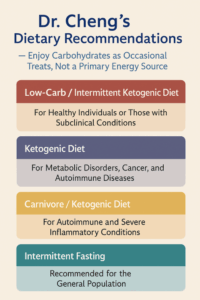 Modern chronic disease is often driven by insulin resistance, mitochondrial dysfunction, and chronic inflammation. A well-formulated low-carb or ketogenic diet, paired with intermittent or prolonged fasting, helps restore metabolic flexibility, reduce inflammation, and enhance autophagy and mitochondrial repair.
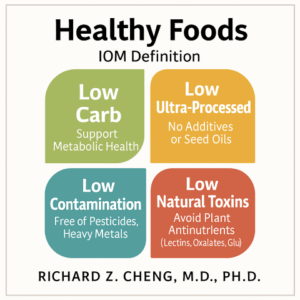
Minimizing ultra-processed foods-including industrial seed oils-is critical to reducing inflammation and metabolic damage.
Key Tools: Carnivore or ketogenic diet, time-restricted eating, prolonged fasting (2-7 days/month), minimizing ultra-processed foods (including seed oils).
3. Orthomolecular Nutrition
 Most patients today are chronically deficient in essential nutrients-even those eating “healthy”diets. IOM employs high-dose, therapeutic nutrient repletion tailored to the individual. Nutrients like vitamin C, D3, K2, magnesium, niacin, omega-3s, and zinc are foundational to immune, neurological, and mitochondrial health.
Key Tools: High-dose vitamins/minerals, nutrient testing, individualized protocols.
4. Detoxification & Elimination
Environmental toxins (pesticides, plastics, heavy metals, endocrine disruptors) are silent drivers of disease. The body’s detox pathways-especially liver and gut-must be supported to handle modern toxin loads. Patients often improve significantly when hidden toxic burdens are identified and reduced.
Key Tools: Exercise, sweating, liver/gut detox programs, toxin testing, sauna, binders, clean air/food/water.
5. Hormone & Rhythm Balance
Hormonal balance is central to energy regulation, mental health, metabolic stability, and healthy aging. The thyroid, adrenal, and sex hormones form the core triad of the endocrine system-and imbalances in any of these can profoundly affect overall well-being. IOM places strong emphasis on identifying and correcting these dysfunctions through lifestyle changes, targeted nutrition, and, when appropriate, bioidentical hormone replacement therapy (BHRT). Restoring circadian rhythm is equally vital to hormonal regulation and long-term vitality.
Key Tools: Comprehensive thyroid, adrenal, and sex hormone panels; BHRT; circadian rhythm optimization; nutritional and stress-modulating interventions.
6. Gut & Microbiome Health
The gut is central to nutrient absorption, immune regulation, mood, and detoxification. Dysbiosis is common in modern populations, often exacerbated by antibiotics, ultra-processed foods (UPFs), natural toxins inherent in plant-based foods (such as gluten, lectins, oxalates, and phytoestrogens), environmental toxicants, and chronic stress. A healthy, low-carb diet-free from refined sugars, industrial seed oils, and chemical additives-is often the first and most critical step in restoring gut health. This dietary reset reduces inflammation, starves harmful microbes, and supports microbial diversity and intestinal barrier integrity.
Key Tools: Digestive support, fermented foods, probiotics, elimination diets, low-toxin low-carb diet, stool testing.
7. Mindset, Meaning & Connection
Chronic illness is not just physical-it involves the psyche. Cultivating hope, purpose, and emotional resilience is vital to healing. This includes releasing trauma, reducing fear, and reconnecting with community, nature, and inner values.
Key Tools: Gratitude, counseling, spiritual practice, group support, nature immersion.
Conclusion: A Call to Reframe Health
The body doesn’t want to be sick-it wants to heal. But healing requires the right conditions. If a patient remains unwell despite normal labs, it’s often because one or more foundational systems are out of alignment.
These seven pillars of Integrative Orthomolecular Medicine are not alternative medicine. They are foundational medicine.
In the end, health is not found in a prescription bottle-it’s built, day by day, through how we live, eat, think, and connect.
Note: This article represents the views of the author and does not necessarily reflect those of all members of the Orthomolecular Medicine News Service editorial board. It is intended for educational purposes and is not medical advice. Individuals are encouraged to seek integrative medical intervention from their physicians, including those affiliated with OMNS. The Seven Pillars approach described herein is endorsed by many leading integrative practitioners, including Dr. Ilyes Baghli, President of the International Society for Orthomolecular Medicine. Orthomolecular medicine practitioners emphasize high-dose, individualized, and optimal nutrition therapy as a cornerstone of health restoration and disease prevention.
About the Author
Richard Z. Cheng, M.D., Ph.D.
Physician, Scientist, Educator, and Global Advocate for Integrative Orthomolecular Medicine
Editor-in-Chief, Orthomolecular Medicine News Service
Dr. Cheng is a U.S.-trained, board-certified anti-aging and cancer specialist with active practices in the United States and China. He specializes in integrative and orthomolecular medicine, with expertise in low-carbohydrate nutrition, high-dose vitamin therapy, anti-aging, and functional medicine. He also serves as a global health educator, consultant, and leading advocate for root-cause, nutrition-based medical reform.
Read Dr. Cheng’s Q&A and additional writings at: https://rzchengmd.substack.com
References below.
Nutritional Medicine is Orthomolecular Medicine
Orthomolecular medicine uses safe, effective nutritional therapy to fight illness. For more information: http://www.orthomolecular.org
Subscribe for free at http://orthomolecular.org/subscribe.html or visit the OMNS archive link at http://orthomolecular.org/resources/omns/index.shtml.
Find a Doctor
To locate an orthomolecular physician near you: http://orthomolecular.org/resources/omns/v06n09.shtml
The peer-reviewed Orthomolecular Medicine News Service is a non-profit and non-commercial informational resource.
Measure Your Levels Today

Create your custom home blood spot kit to help determine if you are getting enough of the following nutrients shown to benefit overall health, along with other measures, including:
- Vitamin D
- Omega-3 Index plus Omega-3:Omega-6 and AA:EPA Ratios
- Magnesium (plus Zinc, Copper, Selenium, Lead, Cadmium & Mercury)
- hsCRP
- HbA1c
- Type 1 Diabetes Autoantibodies
- TSH
 Vitamin D
Enroll and test your levels today, learn what steps to take to improve your status of omega-3s, vitamin D and other nutrients and blood markers, and take action! By enrolling in the GrassrootsHealth projects, you are not only contributing valuable information to everyone, you are also gaining knowledge about how you could improve your own health through measuring and tracking your nutrient status, and educating yourself on how to improve it.
Enroll in D*action and Test Your Levels Today!