
Published on February 9, 2026

… And the Importance of Measuring Blood Levels
Key Points
- Adequate vitamin D supports muscle strength and growth by regulating muscle protein synthesis, fast-twitch muscle fibers, and neuromuscular coordination.
- Vitamin D helps regulate body fat and metabolic health, improving insulin sensitivity, reducing inflammation, and limiting excessive fat cell growth.
- Because vitamin D is fat-soluble and sequestered in adipose tissue, individuals with higher body fat often require higher intakes to reach the same blood levels, making standardized dosing unreliable.
- Maintenance dosing must match the dose required to achieve a target blood level; lowering intake after reaching sufficiency predictably leads to declining vitamin D levels.
 I enjoyed reading a recent article titled Vitamin D’s Hidden Power: The Science Behind Building Muscle Instead of Storing Fat, with several key points summarized below. The article had a lot of great facts about vitamin D and its role in muscle function, body composition, metabolic health, and weight regulation (along with a few misconceptions, a couple of which are also noted below).
Most of all, I appreciated the focus on measuring vitamin D status and dosing according to a desired target level of 50-80 ng/ml, since many articles fall short and miss that very important component of how to utilize vitamin D for optimal health.
Vitamin D receptors (VDRs) are widely distributed throughout the body, including in skeletal muscle, adipose (fat) tissue, and metabolic organs, underscoring its systemic influence beyond bone health. What ultimately determines whether vitamin D can exert these effects is the vitamin D status, or the amount of vitamin D in our blood, measured as serum 25-hydroxyvitamin D [25(OH)D]. Intake alone does not predict biological activity, and two people taking the same dose can end up with very different blood levels and very different physiological outcomes. This makes testing and individualized optimization essential, particularly when vitamin D is being used to support extra-skeletal functions such as maintaining muscle health, physical performance, or healthy body weight.
How Vitamin D Supports Muscle Growth and Strength
Vitamin D directly influences muscle at the cellular level. Muscle cells express vitamin D receptors, which regulate genes involved in muscle protein synthesis, muscle fiber size, and neuromuscular coordination.
Adequate vitamin D status has been associated with:
- Increased proportion and function of type II (fast-twitch) muscle fibers, which are essential for strength, power, and injury prevention
- Improved muscle contraction efficiency and reduced risk of muscle weakness
- Enhanced neuromuscular signaling, improving balance, coordination, and physical performance
Vitamin D also appears to support muscle recovery by modulating inflammation and oxidative stress following exercise. When vitamin D levels are low, muscle tissue may be less responsive to training stimuli, making it harder to build or maintain lean mass, even with consistent exercise.
Vitamin D, Fat Tissue, and Body Weight Regulation
Vitamin D also plays a critical role in fat metabolism and body composition, helping to regulate how fat cells grow, store energy, and release inflammatory signals.
Key mechanisms include:
- Regulation of adipogenesis (fat cell formation): Vitamin D signaling helps limit excessive fat cell differentiation and expansion
- Improved insulin sensitivity: Adequate vitamin D supports glucose uptake in muscle and reduces insulin resistance, shifting energy use away from fat storage
- Lower chronic inflammation: Fat tissue in vitamin D–deficient individuals tends to be more inflamed, which further disrupts metabolism and muscle function
It is incredibly important to note that, since vitamin D is fat-soluble, it becomes sequestered in adipose tissue, making it less available to other tissues and organs throughout the body. Individuals with higher body fat often require significantly higher vitamin D intake to achieve the same blood levels as lean individuals. This is one reason why standardized dosing frequently fails and why blood testing is essential.
Vitamin D Helps Preserve Lean Mass During Weight Loss
During calorie restriction or weight loss, the body often loses muscle along with fat. Adequate vitamin D status appears to protect lean mass, helping to preserve muscle while fat mass is reduced. This has important implications for:
- Sustainable weight loss
- Metabolic rate maintenance
- Strength, mobility, and long-term health
By supporting muscle protein synthesis and reducing inflammation, vitamin D helps the body maintain a healthier lean-to-fat ratio, especially when paired with resistance training and adequate protein intake.
Key Points: Why Measuring Vitamin D Levels Is Essential
Because vitamin D’s effects on muscle and fat are dose-dependent at the blood level, optimization requires feedback.
- Vitamin D intake does not reliably predict blood levels
- Body size, baseline deficiency, genetics, sun exposure, and absorption all affect the vitamin D dose response and how the body utilizes vitamin D
- Measuring 25(OH)D and dosing using the GrassrootsHealth Vitamin D Calculator allows intake to be adjusted with precision
Without testing, individuals may remain deficient despite supplementation or unknowingly decrease levels, losing hard-earned progress in muscle strength and metabolic health.
Clarifying Two Common Vitamin D Misconceptions
While the original article provides a lot of helpful context, two points deserve clarification:
1. Morning Sunlight and UVB Exposure
The article incorrectly implies that vitamin D can be produced from morning sunlight – a misconception that continues to be frequently shared. In reality, vitamin D synthesis in the skin requires UVB radiation, which is absent in early morning and late afternoon sunlight due to the low solar angle. When the sun is low in the sky, UVB wavelengths are filtered out by the atmosphere before they reach the Earth’s surface. As a result, vitamin D production occurs only when the sun is sufficiently high (typically around solar midday) and even then, only under appropriate conditions. In addition, at northern latitudes, there is essentially no UVB available during the winter months, meaning that vitamin D synthesis from sunlight is not possible regardless of time spent outdoors. Because UVB availability is constrained by latitude, season, and solar angle, and completely absent at certain times and places, it can be incredibly difficult to rely on sun exposure alone to maintain adequate vitamin D status.
2. Maintenance Dose Confusion
We often hear individuals say that they stopped taking vitamin D once they reached a sufficient level, not knowing that discontinuing supplementation would result in the vitamin D level dropping back down. Similarly, the article suggests that after reaching a target vitamin D level, individuals can switch to a standardized “maintenance dose” such as 2,000–4,000 IU per day. In reality, the maintenance dose better matches the dose that was required to achieved that blood level and is not a generic recommendation that works the same for everyone.
For example:
- If it took 8,000 IU/day over a course of 2-3 months to reach a serum 25(OH)D level of 50 ng/mL, that intake would be the dose needed to maintain a level of 50 ng/ml (aka the maintenance dose).
- Reducing intake to 2,000–4,000 IU/day in this scenario would predictably lead to a decline in vitamin D blood levels over time.
In Conclusion
Vitamin D plays a foundational role in muscle strength, recovery, fat metabolism, and healthy body composition, but these benefits depend on achieving and maintaining an adequate blood level, not simply taking a supplement. The most effective approach is to:
- Measure vitamin D status
- Adjust intake, sun exposure, diet, co-nutrients, etc. based on results
- Re-test to confirm long-term optimization
When vitamin D is treated as a measurable, adjustable, gene-regulating nutrient, rather than a one-size-fits-all supplement, it can be used as a powerful ally in supporting optimal health, including muscle health, metabolic resilience, and a lean, healthy body weight.
Evidence-Based Tests for Improving Cardiovascular Health – Special Savings This Month!
 Measuring vitamin D in combination with other health markers, such as hsCRP and the omega fatty acids, offers meaningful insight into inflammation, vascular health, and overall cardiovascular resilience.
February is Heart Health Month! Understanding your vitamin D status alongside other key cardiovascular markers can help guide informed decisions about lifestyle, nutrition, and targeted interventions that support long-term health for your heart and cardiovascular system.
Save 15% this month on home test kits measuring key markers of heart and cardiovascular health!
Check Out the Heart-Health Sale Now!
Create Your Custom Home Test Kit
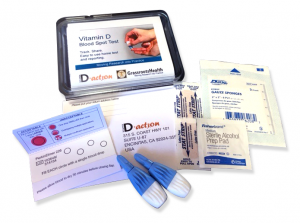 Measure your vitamin D levels at home as part of the D*action project! To know if you are getting enough, make sure you test today!
You can also measure your:
- Vitamin D
- Magnesium PLUS Essential and Toxic Elements
- Omega-3 Fatty Acids
- hsCRP
- HbA1c
- TSH
- Type 1 Diabetes Autoantibodies
Did you know that each of the above can be measured at home using a simple blood spot test? As part of our ongoing research project, you can order your home blood spot test kit to get your levels, followed by education and steps to take to help you reach your optimal target levels. Start by enrolling and ordering your kit to measure each of the above important markers, and make sure you are getting enough of each to support better mood and wellbeing!
Create your custom home test kit today. Take steps to improve the status of each of these measurements to benefit your overall health. With measurement you can then determine how much is needed and steps to achieve your goals. You can also track your own intakes, symptoms and results to see what works best for YOU.
How Can You Use this Information for YOUR Health?
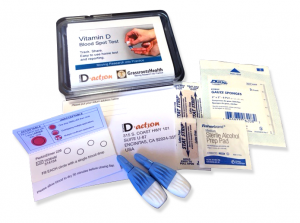
Having and maintaining healthy vitamin D and other nutrient levels can help improve your health now and for your future. Measuring is the only way to make sure you are getting enough!
STEP 1 Order your at-home blood spot test kit to measure vitamin D and other nutrients of concern to you, such as omega-3s, magnesium, essential and toxic elements (zinc, copper, selenium, lead, cadmium, mercury); include hsCRP as a marker of inflammation or HbA1c for blood sugar health
STEP 2 Answer the online questionnaire as part of the GrassrootsHealth study
STEP 3 Using our educational materials and tools (such as our dose calculators), assess your results to determine if you are in your desired target range or if actions should be taken to get there
STEP 4 After 3-6 months of implementing your changes, re-test to see if you have achieved your target level(s)