

Published on May 9, 2026

Avoiding the sun may prevent some skin cancer deaths, but at the cost of overall health and longevity
Key Points
- Moderate sunlight exposure is consistently associated with lower all-cause and cardiovascular mortality across large population studies
- Focusing only on skin cancer risk may overlook a much larger impact of sunlight on overall health and longevity
- In one large analysis, low UV exposure was associated with ~75 additional deaths for every 1 skin cancer death prevented
- The goal is not to avoid the sun, but to achieve regular, non-burning exposure tailored to individual factors
 A recent pre-print of a large-scale UK Biobank analysis by Gu et al. (involving over 400,000 participants) is prompting a critical re-evaluation of how we think about sunlight exposure and health. While public health messaging has long emphasized limiting ultraviolet (UV) exposure to reduce skin cancer risk, this research adds to the growing body of evidence demonstrating a broader and more complex reality: sunlight appears to play a significant role in longevity and may even reduce overall mortality.
The study directly compared skin cancer mortality with all-cause mortality, revealing a striking imbalance. While avoiding UV exposure may prevent a relatively small number of skin cancer deaths, it was associated with a substantially larger increase in deaths from other causes.
According to the authors,
Low UV exposure was estimated to prevent:
39 melanoma deaths + 1 keratinocyte cancer death = 40 skin cancer deaths prevented
But it was also estimated to result in:
2,982 additional all-cause deaths
This equates to approximately 75 additional deaths for every 1 skin cancer death prevented.
In other words, when viewed through the lens of total mortality, not just skin cancer, the tradeoff looks very different. Efforts to minimize UV exposure may reduce a small number of skin cancer deaths, but at the same time may be associated with a much larger increase in deaths from cardiovascular disease, cancer, and other causes.
This comparison highlights a critical gap in how risk is often communicated. Skin cancer, while important, represents only a small fraction of total mortality, whereas cardiovascular disease and other chronic conditions account for the vast majority of deaths. Focusing on one outcome in isolation may obscure the broader impact on overall health and longevity.
Which raises an important question for both clinicians and the public: are we focusing too narrowly on skin cancer risk while overlooking the much larger impact on all-cause mortality?
“From a public health perspective, the most important question is not how sunlight affects one specific disease, but how it influences overall survival. Guidance to avoid sun exposure should be accompanied by an equally clear explanation of the potential health risks associated with too little sunlight.”
Video Spotlight: Interpreting the Findings in Context
In the video above, Roger Seheult, MD breaks the study findings down by reviewing the study charts in depth and breaking them down in a clear and accessible way, highlighting the potential, large tradeoff between melanoma risk and overall mortality. He emphasizes that while melanoma is a serious concern, it represents a relatively small portion of total deaths compared to cardiovascular disease and other chronic conditions; areas where sunlight exposure may provide meaningful benefits.
The discussion also reinforces an important nuance: sunlight’s impact on health is not limited to vitamin D production. Mechanisms such as nitric oxide release, immune modulation, and circadian rhythm regulation are explored as additional ways sunlight may influence long-term health outcomes (a topic to be covered in detail throughout Sunshine Month). At the same time, the video underscores that these findings are observational and should be interpreted thoughtfully, not as a call for excessive sun exposure, but as a prompt for more balanced guidance.
What More Does the Research Show?
The Gu study is just one of several others to help put these findings into context by directly examining sunlight exposure in relation to mortality outcomes across different populations. They analyzed 419,007 participants using a multidimensional UV exposure score (Sun-BEEM) that captures both environmental and behavioral sunlight exposure. It is one of the most comprehensive attempts to quantify the balance between the risks and benefits of UV exposure.
Associations of habitual ultraviolet exposure with all-cause and cause-specific mortality

(Gu et al., Fig. 2A); Watch the video above for an in-depth explanation of how to read this forest plot
Key findings:
- Higher UV exposure was associated with a 16% lower risk of all-cause mortality (HR 0.84)
- Cardiovascular mortality risk was reduced by ~23% at higher exposure levels (HR ~0.77)
- Non-skin cancer mortality risk was reduced by ~11% (HR ~0.89)
- No clear increase in skin cancer mortality, despite higher incidence of non-melanoma skin cancers
- Modeling suggested that higher UV exposure could prevent substantially more deaths from cardiovascular disease and cancer than the number potentially attributable to skin cancers
- Results point toward vitamin D–independent pathways, including immune, vascular, and neuroendocrine effects
Another study by Nazeeh et al. (2025) of 83,205 North American participants evaluated time spent outdoors during daylight and its association with mortality using detailed lifestyle and health data.

Key findings:
- A reverse J-shaped relationship was observed, suggesting optimal benefit with moderate exposure
- Spending ~2 hours/day outdoors (vs. 30 minutes) was associated with:
o 10% lower all-cause mortality risk (HR 0.90)
o 11% lower cardiovascular mortality risk (HR 0.89)
o 17% lower non-cancer, non-CVD mortality risk (HR 0.83) - No significant association with cancer mortality
- Benefits were stronger in warmer months, suggesting a role for sunlight/UV exposure
- Associations remained after adjusting for physical activity and other lifestyle factors
“…moderate UV exposure from the sun, without burning, is a health benefit and should be recommended as such.” Hoel and De Gruijl (2018)
Additional studies on the relationship between sunshine exposure and mortality, such as those by Stevenson, Lindqvist, and others, will be reviewed later this month – so stay tuned!
Not All Sun Exposure Is the Same
Remember, the research does not suggest that more sun is always better. The highest risk comes from intermittent, excessive exposure that leads to sunburn, which has consistently been associated with increased melanoma risk. In contrast, regular, moderate exposure, tailored to skin type, location, and season appears to provide benefit without the same level of risk.
This distinction is critical. Public health messaging that promotes complete sun avoidance may inadvertently contribute to poorer overall health outcomes if it leads to chronically low sunlight exposure and low vitamin D levels.
Any recommendation to avoid sun exposure should also acknowledge that insufficient exposure may carry its own risks, potentially impacting overall mortality more than the risk it aims to reduce.
Putting the Findings into Perspective
As with any observational study, these findings show association rather than direct causation. Individuals who spend more time outdoors may also engage in other healthy behaviors such as physical activity, which could contribute to improved outcomes. However, the consistency of findings across multiple large cohorts strengthens the case that sunlight exposure plays a meaningful role in overall health.
Taken together, this research supports a more nuanced approach to sun exposure, one that prioritizes overall health rather than focusing on a single outcome. The goal is not to avoid the sun, but to engage with it wisely.
A practical framework includes:
- Getting regular, non-burning sun exposure
- Adjusting exposure based on skin type, UV index, time of day, and season
- Monitoring vitamin D levels and using supplementation when needed
- Taking protective measures (shade, clothing, sunscreen) when approaching burn risk
Make Sure You Are Getting Enough of Both Sunshine & Vitamin D
It is important to incorporate safe, sensible sun exposure into a regular routine, just as it is important to make sure you are getting enough vitamin D. Because the sun produces many health-benefiting molecules in addition to vitamin D, sunshine exposure cannot be replaced with taking a supplement.
It is also important not to stop supplementing with vitamin D during the summer. Most people do not make enough vitamin D from sunshine alone, due to their lifestyle and other factors, and therefore must rely on supplementation to maintain optimal vitamin D levels of 40-60 ng/ml (100-150 nmol/L).

This Sunshine Month, get 10% off your home blood spot test kits PLUS the free Sunshine eBook when using the code SUNMONTH26 at checkout. Or, save on 2 Vitamin D test kits (for before and after summer sun) plus the Sunshine eBook with our Sunshine Month Bundle here!
Measure Your Vitamin D Level Today
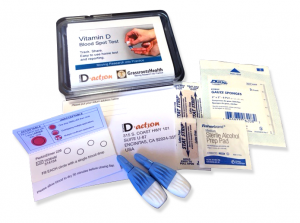 Having and maintaining healthy vitamin D levels and other nutrient levels can help improve your health now and for your future. Choose which additional nutrients to measure, such as your omega-3s and essential minerals including magnesium and zinc, by creating your custom home test kit today. Take steps to improve the status of each of these measurements to benefit your overall health. With measurement you can then determine how much is needed and steps to achieve your goals. You can also track your own intakes, symptoms and results to see what works best for YOU.
Enroll in D*action and Test Your Levels Today!
How Can You Use this Information for YOUR Health?
Having and maintaining healthy vitamin D and other nutrient levels can help improve your health now and for your future. Measuring is the only way to make sure you are getting enough!
STEP 1 Order your at-home blood spot test kit to measure vitamin D and other nutrients of concern to you, such as omega-3s, magnesium, essential and toxic elements (zinc, copper, selenium, lead, cadmium, mercury); include hsCRP as a marker of inflammation or HbA1c for blood sugar health
STEP 2 Answer the online questionnaire as part of the GrassrootsHealth study
STEP 3 Using our educational materials and tools (such as our dose calculators), assess your results to determine if you are in your desired target range or if actions should be taken to get there
STEP 4 After 3-6 months of implementing your changes, re-test to see if you have achieved your target level(s)