

Published on July 14, 2026

Our heads of public health are continuing to distribute the wrong information
Key Points
- Current vitamin D recommendations are based on a well-documented statistical error that underestimated the vitamin D needs of individuals.
- Dr. James Lyons-Weiler explains why using study averages instead of individual data led to RDAs and Upper Intake Levels that are too low for much of the population.
- His simple bridge-and-truck analogy illustrates how confusing group averages with individual variation can lead to flawed public health policy and real-world consequences.
- Despite more than a decade of published evidence confirming the mistake, federal vitamin D recommendations have yet to be updated to reflect current science.
 GrassrootsHealth was honored to partner with James Lyons-Weiler, PhD, and IPAK-EDU for our Vitamin D Dosing Policy Update: An Expert Panel Discussion, held on May 21, 2026. You can view the full 3 ½ hour policy discussion recording here.
We sincerely thank Dr. Lyons-Weiler for his partnership in hosting the event. He has long been an advocate for scientific integrity, transparency, and evidence-based public health policy, and his contributions to the discussion helped frame one of the central issues surrounding current vitamin D recommendations: the fact that today’s Recommended Dietary Allowance (RDA) and Upper Intake Level (UL) continue to rely on statistical methods that have long been shown to be incorrect.
In this presentation, Dr. Lyons-Weiler explains, in a way that is accessible even to those without a statistical background, how a single inferential mistake continues to influence vitamin D policy today. His bridge and truck analogy described below provides one of the clearest illustrations available for understanding why the Institute of Medicine’s original calculations underestimated the amount of vitamin D needed by most individuals.
You can watch Dr. James Lyons-Weiler’s individual presentation below or continue reading for a detailed summary of his remarks.
A Long-Recognized Problem That Remains Unaddressed
Dr. Lyons-Weiler opened his presentation by describing how his interest in vitamin D dosing began after watching a presentation by his longtime colleague Dr. Keith Baggerly (son of GrassrootsHealth’s founder Carole Baggerly) whose work help bring widespread attention to the statistical problems underlying current vitamin D recommendations. Having previously worked together through the Early Detection Research Network in cancer research, Dr. Lyons-Weiler became increasingly interested in understanding how such an important public health recommendation, based on flawed analysis, could be left unaddressed.
He also highlighted a paper titled A Statistical Error in the Estimation of the Recommended Dietary Allowance for Vitamin D published by Veugelers and Ekwaru in 2014 that exposed and examined the Institute of Medicine’s statistical approach and demonstrated why it underestimated true vitamin D requirements. Subsequent analyses, including work using data from the GrassrootsHealth cohort, confirmed that considerably higher vitamin D intakes are required to achieve target serum 25(OH)D concentrations in nearly all individuals than those suggested by the current RDA.
The mistake has been thoroughly documented in the peer-reviewed literature and is no longer considered controversial. Even the National Academies have acknowledged that the original statistical approach was incorrect. At this point, the evidence has accumulated for more than a decade, and policy simply has not caught up.
The Fundamental Statistical Mistake
When creating the guidelines, the Institute of Medicine attempted to estimate vitamin D intakes that would meet the needs of nearly all individuals. However, they based their calculations on the averages reported from individual studies, rather than the variability observed among the individual participants within those studies. While this may sound like a subtle distinction, it dramatically changes the outcome.
Study averages naturally cluster much more closely together than individual responses because averaging smooths out much of the real biological variation that exists across people, a statistical phenomenon often referred to as regression toward the mean. By treating study averages as though they represented individual people, the Institute of Medicine substantially underestimated how much variation exists in vitamin D requirements. As a result, recommendations intended to meet the needs of 97.5% of individuals were instead based on the much narrower variation between study averages, producing intake recommendations that are too low for much of the population.
The Bridge and Truck Analogy
To help explain this concept, Dr. Lyons-Weiler created the following illustration.
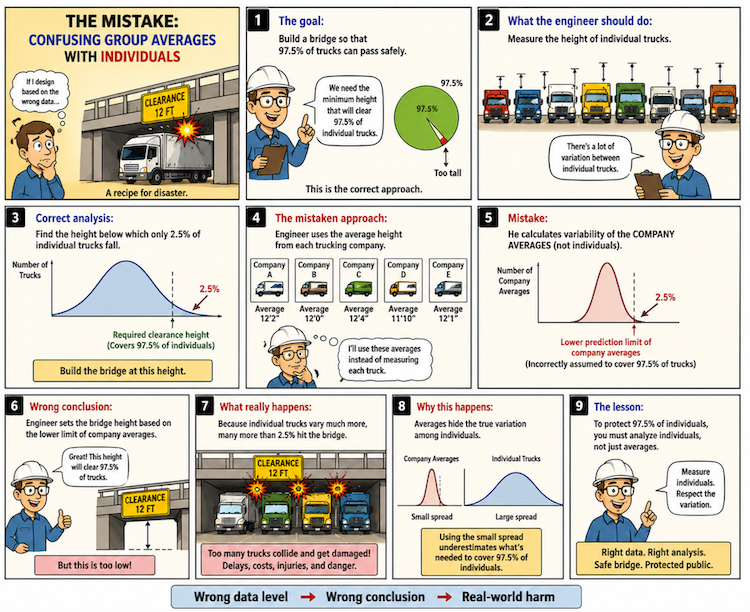
The analogy imagines an engineer designing a bridge that must safely allow 97.5% of trucks to pass underneath. The correct approach would be to measure the height of individual trucks, determine how much variation exists among them, and build the bridge high enough so that only the tallest 2.5% would require rerouting.
Instead, imagine the engineer measuring only the average truck height for each trucking company. Because company averages are much less variable than the heights of individual trucks, the engineer concludes that a lower bridge is sufficient. The bridge is built too low. When actual trucks begin using the bridge, many more than 2.5% strike the overpass, causing accidents, delays, property damage, injuries, and unnecessary costs.
The problem was never that the engineer performed the calculations incorrectly. The problem was that the engineer analyzed the wrong data.
And as Dr. Lyons-Weiler summarized through the graphic:
Wrong data level → Wrong conclusion → Real-world harm.
A Simple Everyday Example
Dr. Lyons-Weiler offered another analogy to illustrate the same statistical mistake. Imagine someone says: “Most classrooms averaged above a passing grade.” That statement is not equivalent to saying: “97.5% of students passed.”
A classroom average tells us very little about how individual students performed. Some students may have earned excellent grades while others failed entirely, yet the classroom average could still appear satisfactory. Likewise, averages from supplementation studies cannot be used to estimate the vitamin D intake required by nearly every individual. The variability among individuals is far greater than the variability among study averages.
The Consequences of Failing to Update Public Policy
Dr. Lyons-Weiler emphasized that while federal agencies continue to distribute recommendations that are known to be based on outdated statistical assumptions, public health will continue to suffer resulting harm. According to him:
- The vitamin D RDA has never been revised to reflect the corrected statistical analyses.
- The Upper Intake Level similarly has not been updated based on the corrected evidence.
- Government websites continue to communicate recommendations that underestimate vitamin D requirements for many individuals.
He argued that correcting these recommendations would not require an entirely new scientific discovery. Much of the work has already been done. Instead, public health agencies must be willing to translate the existing evidence into updated policy and translate that policy through public facing websites and information.
Efforts to Bring the Issue to Federal Attention
Dr. Lyons-Weiler shared that he has personally discussed this issue with Robert F. Kennedy Jr., current Secretary of the U.S. Department of Health and Human Services (HHS). He prepared a written summary describing the statistical problem, which was subsequently distributed within HHS. While he expressed hope that meaningful policy changes would follow, he acknowledged that little visible action has occurred thus far.
For this reason, he believes continued public education and scientific advocacy remain essential.
The goal of the May 21 panel discussion, he explained, was to help communicate this issue more broadly and encourage policymakers to recognize that the scientific evidence has changed, even if official policy has not.
Beyond the RDA: Broader Implications for Medicine
Dr. Lyons-Weiler concluded by noting that correcting vitamin D recommendations represents only one part of a much larger conversation. He suggested that future policy discussions should also consider:
- Updating medical education to reflect current vitamin D science.
- Evaluating how vitamin D deficiency may influence the interpretation of clinical trials.
- Considering whether participants with known vitamin D deficiency should remain untreated while enrolled in research studies.
- Recognizing the important consequences of vitamin D deficiency during pregnancy, childhood, adolescence, and older adulthood.
- Ensuring that healthcare policy evolves as scientific knowledge advances.
These topics are addressed in detail by other presenters of the May 21st expert panel. As he summarized, the scientific evidence has shifted dramatically over the past decade, but policy has largely remained unchanged. That disconnect has real consequences for population health and deserves careful attention from policymakers, healthcare professionals, and the public alike.
Watch and Share the Full Expert Panel Recording
Dr. Lyons-Weiler’s presentation served as an excellent introduction to the broader themes explored throughout the May 21 policy discussion. While his focus was on the statistical foundation underlying current vitamin D recommendations, the remaining panelists expanded on the clinical, epidemiological, biological, and public health implications of those errors. Together, their presentations make a compelling case that today’s vitamin D policies no longer reflect the best available scientific evidence. As research continues to advance, updating recommendations to account for individual variability and modern statistical analyses will be essential for improving public health and helping individuals achieve optimal vitamin D status.
Visit Dr. Lyons-Weiler’s Popular Rationalism Substack and IPAK-EDU, both of which expand his educational efforts geared towards individuals interested in advancing better science and public policy.
A Call to Action from Executive Director, Jen Aliano
Please help get this important discussion into the hands of the people who can make a difference.
Our goal is to encourage policymakers, public health leaders, medical organizations, and guideline committees to review the evidence presented by this panel of leading vitamin D experts and consider updating vitamin D policies and clinical guidelines to better reflect the current science.
If you know anyone involved in health policy, public health, government, healthcare leadership, medical societies, or guideline development, please share this presentation with them. Even one introduction or one share could help move this conversation forward.
The easiest ways to help are:
- Share the GrassrootsHealth blog about the discussion (includes built-in social sharing buttons):
https://www.grassrootshealth.net/blog/leading-experts-call-for-changes-to-vitamin-d-policy-watch-the-discussion/ - Repost or share the GrassrootsHealth social media posts on
LinkedIn
X.com
Facebook - Share the YouTube recording directly
Thank you for helping us bring the latest vitamin D science to those in a position to improve public health policy,
Jen Aliano, MS
Executive Director, GrassrootsHealth
Are You Getting Enough Vitamin D & Other Health Boosting Nutrients?
Measuring our levels of vitamin D and other important nutrients and health markers can be considered one way to check-in with our health status and guide us towards the steps to take next in improving and supporting our health.
 Having and maintaining healthy vitamin D levels and other nutrient levels can help improve your health now and for your future. Choose which to measure, such as your vitamin D, omega-3s, and essential minerals including magnesium and zinc, by creating your custom home test kit today. Take steps to improve the status of each of these measurements to benefit your overall health. You can also track your own intakes, symptoms and results to see what works best for YOU.
Enroll and test your levels today, learn what steps to take to improve your status of vitamin D (see below) and other nutrients and blood markers, and take action! By enrolling in the GrassrootsHealth projects, you are not only contributing valuable information to everyone, you are also gaining knowledge about how you could improve your own health through measuring and tracking your nutrient status, and educating yourself on how to improve it.
How Can You Use this Information for YOUR Health?
Having and maintaining healthy vitamin D and other nutrient levels can help improve your health now and for your future. Measuring is the only way to make sure you are getting enough!
STEP 1 Order your at-home blood spot test kit to measure vitamin D and other nutrients of concern to you, such as omega-3s, magnesium, essential and toxic elements (zinc, copper, selenium, lead, cadmium, mercury); include hsCRP as a marker of inflammation or HbA1c for blood sugar health
STEP 2 Answer the online questionnaire as part of the GrassrootsHealth study
STEP 3 Using our educational materials and tools (such as our dose calculators), assess your results to determine if you are in your desired target range or if actions should be taken to get there
STEP 4 After 3-6 months of implementing your changes, re-test to see if you have achieved your target level(s)
You may also like
 To Fear or Not to Fear? The Complicated Relationship Between Skin Cancer, Sunscreen, and Vitamin D
 Announcing Our Updated & Expanded Vitamin D eCourse Approved for 11 Nursing CEUs!
 Moving With Less Discomfort: What Your Omega-3 Index Can Tell You About Inflammation and Joint Health
 Vitamin D: Everything You Need to Know… and More