

Published on December 15, 2025
…and Why the Testing Method Matters
Key Points
- Differences between vitamin D test results often reflect the testing method used rather than a true change in vitamin D status.
- Large-scale research shows that commonly used immunoassays can over- or underestimate vitamin D levels due to biological and technical limitations.
- LC-MS/MS directly measures vitamin D molecules and is considered the gold-standard method used in research and international standardization programs.
- GrassrootsHealth uses CLIA-certified, DEQAS-participating laboratories and LC-MS/MS blood spot testing to provide accurate, reliable results suitable for tracking vitamin D over time.

Over the years, we have heard this question asked several times:
“Why is the vitamin D result I received from my doctor different from the one I got from you?”
The answer usually has to do with how vitamin D was measured, or what testing method was used.
A peer-reviewed study published this month (December, 2025) by Racz et al. analyzed nearly 60,000 vitamin D test results collected over 20 years and found that vitamin D levels can look higher or lower not because someone’s vitamin D level had changed, but because the lab’s testing method did. In fact, different methods often produce different results from the same blood sample.
This research demonstrates why different tests done around the same time can give different answers, and why GrassrootsHealth partners only with labs who use LC-MS/MS, the most accurate method available for measuring vitamin D status.
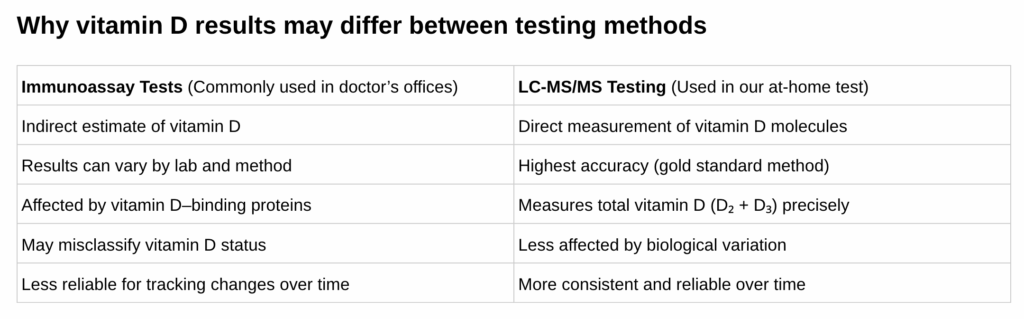
Most Common Methods Used to Measure Vitamin D
Most routine vitamin D tests used by doctor’s offices and in clinics rely on immunoassays. These tests are widely available and relatively inexpensive, but they have known limitations.
In contrast, LC-MS/MS (liquid chromatography–tandem mass spectrometry) is a highly specific laboratory method used as the reference standard in vitamin D research and standardization programs.
In the study mentioned above, researchers compared multiple testing methods used over time and found statistically significant differences in measured vitamin D levels depending on the assay used. In other words, two people with the same blood sample could receive different vitamin D results depending solely on how it was tested.
Why Immunoassays Can Give Different Results
Vitamin D does not circulate freely in the blood. Most of it is tightly bound to proteins, especially vitamin D–binding protein (DBP). To measure vitamin D accurately, a test must fully release it from those proteins.
Many automated immunoassays:
- Do not always fully release vitamin D from its binding proteins
- May measure vitamin D2 and D3 unevenly
- Are more affected by changes in DBP levels, such as during pregnancy, hormone therapy, kidney disease, or inflammation
As a result, immunoassays can underestimate or overestimate true vitamin D status, particularly in people whose physiology differs from “average.”
Why LC-MS/MS Is Different
LC-MS/MS works by physically separating and precisely identifying vitamin D molecules, rather than estimating them indirectly. This allows it to:
- Accurately measure total 25-hydroxyvitamin D (D2 + D3)
- Avoid many of the interferences seen with immunoassays (such as with biotin)
- Align with international vitamin D standardization efforts
In fact, the authors of the study state that LC-MS/MS remains the definitive, gold-standard method for accurate vitamin D measurement, used in research and reference laboratories worldwide. They also emphasize the urgent need for standardization, since inaccurate testing can distort clinical decisions and public-health data.
Why This Can Affect Your Results
Some of the highest vitamin D levels seen over the 20-year period occurred during years when more accurate chromatographic methods were used; not because people suddenly became healthier, but because the test itself changed.
This means:
- A difference between test results does not automatically mean your vitamin D level changed
- It may simply reflect which method was used
- More accurate testing often reveals a truer picture of vitamin D status
It is important to receive results you can rely on—especially if you are tracking vitamin D over time or making decisions about supplementation.
Accuracy and Convenience: LC-MS/MS Meets Home Blood Spot Testing
Using LC-MS/MS does not require a clinic visit. With modern laboratory techniques, dried blood spot samples collected at home can be analyzed using the same high-precision method used in research and reference labs.
This means you can have:
- Gold-standard accuracy
- Convenient, at-home collection
- Results that are better suited for tracking trends over time
Plus, LC-MS/MS aligns with Vitamin D Standardization Program (VDSP) principles and reference measurement procedures, minimizes DBP-related interference, and improves longitudinal comparability—particularly important for pregnancy, chronic disease management, supplementation monitoring, and outcome-based research.
GrassrootsHealth uses only laboratories for vitamin D testing that are CLIA (Clinical Laboratory Improvement Amendments) certified, which ensures the lab conforms to federal regulations regarding testing, and who participate in DEQAS, the Vitamin D Quality Assessment Scheme, which provides control samples to ensure assay accuracy. The blood spot assay is always performed using LC-MS/MS, with validation tests against serum blood draws done at the same time as blood spot collection showing a high level of agreement between the two testing methods.
Given that vitamin D deficiency is both common and correctable, routine testing and personalized supplementation represent one of the most cost-effective, evidence-based interventions available today. Test your vitamin D level and take action today.
Measure Your Vitamin D and Other Important Nutrients
If you haven’t had your vitamin D levels checked recently, now is the time! With so many Americans still falling short, awareness is the first step toward change.
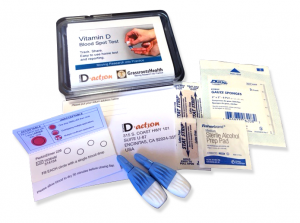
Measuring and calculating a supplementation amount to help reach and maintain a target level, or taking loading doses to correct deficiency faster, could possibly make all the difference in overall health, wellbeing, and how a current disease situation progresses. Test your level now!
Create your custom home blood spot kit by adding any of the following measurements, along with your vitamin D:
- Omega-3 Index (with or without Ratios AA:EPA and Omega-6:Omega-3)
- Magnesium (with additional Elements copper, zinc, selenium, mercury, and cadmium)
- hsCRP as a marker of inflammation and HbA1c as a marker of blood sugar health
Having and maintaining healthy vitamin D levels and other nutrient levels can help improve your health, now and for the future. Enroll and test your levels today, learn what steps to take to improve your status of vitamin D (see below) and other nutrients and blood markers, and take action! By enrolling in the GrassrootsHealth projects, you are not only contributing valuable information to everyone, you are also gaining knowledge about how you could improve your own health through measuring and tracking your nutrient status, and educating yourself on how to improve it.
How Can You Use this Information for YOUR Health?
Having and maintaining healthy vitamin D and other nutrient levels can help improve your health now and for your future. Measuring is the only way to make sure you are getting enough!
STEP 1 Order your at-home blood spot test kit to measure vitamin D and other nutrients of concern to you, such as omega-3s, magnesium, essential and toxic elements (zinc, copper, selenium, lead, cadmium, mercury); include hsCRP as a marker of inflammation or HbA1c for blood sugar health
STEP 2 Answer the online questionnaire as part of the GrassrootsHealth study
STEP 3 Using our educational materials and tools (such as our dose calculators), assess your results to determine if you are in your desired target range or if actions should be taken to get there
STEP 4 After 3-6 months of implementing your changes, re-test to see if you have achieved your target level(s)