
Published on November 10, 2025
Learn more during tomorrow’s Vitamin D Study Hour with Dr. Bruce Hollis – Prenatal Vitamin D and Neurocognitive Outcomes in Children
Key Points
- Dr. Bruce Hollis — Expert on Vitamin D in Pregnancy: A leading researcher in vitamin D metabolism and member of the GrassrootsHealth Scientist Panel, Dr. Hollis has spent over 40 years advancing knowledge on how vitamin D influences maternal and infant health, shaping modern supplementation practices.
- New evidence from the 2025 Voltas et al. study found that low maternal vitamin D, especially in the third trimester, was linked to poorer visual-motor precision and executive function in children at age 4, even after controlling for socioeconomic and lifestyle factors.
- Fewer than 17% of pregnant women in the study had sufficient vitamin D levels, underscoring an urgent public health need for prenatal monitoring and targeted supplementation to support fetal brain development.
- Join tomorrow’s Vitamin D Study Hour, or submit your questions below, to learn more about this study and others demonstrating the link between vitamin D and health outcomes for both the mom and baby

Dr. Bruce W. Hollis, PhD, is a leading expert in nutritional biochemistry, with a specialized focus on vitamin D metabolism during pregnancy and infancy. As a Professor Emeritus at the Medical University of South Carolina (MUSC), he has dedicated over four decades to advancing our understanding of vitamin D’s role in human health. His pioneering research has significantly influenced clinical practices and public health guidelines regarding vitamin D supplementation.
We are honored to have Dr. Hollis be our featured speaker for our next Vitamin D Study Hour research review webinar with Q&A on the topic of Prenatal Vitamin D and Neurocognitive Outcomes in Children – scheduled for tomorrow, Wednesday November 12 at 2pm ET/11am PT.
Registration Closed – Watch the Recording Here
“Not measuring maternal 25(OH)D concentration is analogous to treating hypothyroidism without checking thyroid hormone levels. Monitoring vitamin D status enables tailored supplementation strategies, which may be especially important during critical windows of fetal brain development.” ~ Drs. Hollis & Wagner
Vitamin D in Pregnancy Affects the Lifelong Health of the Offspring
 Multiple studies have shown that vitamin D levels during pregnancy can affect the health of the pregnancy as well as the life-long health of the child. More specifically, research has found that low maternal vitamin D levels during pregnancy were linked to poorer neurocognitive outcomes in children at age 4. Mothers with insufficient vitamin D, particularly during the third trimester, had children who performed worse on tests of executive function and visual-motor precision.
The 2025 study of 289 Spanish mother–child pairs by Voltas et al. adds to the evidence that prenatal vitamin D levels are significantly related to neurocognitive outcomes among children. Vitamin D levels below 20 ng/ml (50 nmol/L) during both the first and third trimesters were linked to lower Visual-Motor Precision scores, suggesting that inadequate prenatal vitamin D may impair fine motor and visuospatial skills. Moreover, deficiency during the third trimester was specifically associated with poorer executive functioning, including difficulties with inhibition, working memory, and metacognitive processes such as planning and organization. These associations persisted even after adjusting for potential confounding factors like socioeconomic status, maternal anxiety, and parental IQ. However, no significant relationship was found between maternal vitamin D levels and overall IQ or language-based measures after adjustment.
Additional Key Points from the Study
Study Objective: To examine how maternal vitamin D status (25(OH)D levels) during the first and third trimesters of pregnancy affects neurocognitive outcomes in children at 4 years of age.
Sample: 289 mother–child pairs from the ECLIPSES cohort in Spain.
Vitamin D Levels:
- Only 16.6% of mothers had sufficient vitamin D (defined as greater than 20 ng/ml or 50 nmol/L) in the first trimester.
- Only 14.9% had sufficient levels in the third trimester — showing widespread deficiency.
Main Findings: Insufficient 25(OH)D levels throughout pregnancy were linked to lower Visual-Motor Precision on the NEPSY-II test (a marker of sensorimotor coordination).
Deficiency during the third trimester was significantly associated with poorer executive function, including:
- Lower Working Memory scores (WPPSI-IV)
- Higher (worse) scores in Inhibition and Metacognition Index (BRIEF-P)
These associations remained significant after adjusting for confounding variables such as maternal age, anxiety, BMI, socioeconomic status, and child diet.
Interpretation:
- First trimester insufficiency mainly impacted visual-motor development.
- Third trimester deficiency most strongly affected executive functioning—skills related to self-regulation, inhibition, and working memory.
Mechanistic Insight: Vitamin D influences fetal brain processes such as neurogenesis, synaptogenesis, differentiation, and myelination, especially in the prefrontal cortex—a region critical for executive function.
The authors emphasize that these findings align with prior research highlighting vitamin D’s role in fetal brain development, particularly in processes such as neurogenesis, synaptogenesis, and myelination, which are especially active in late pregnancy. Given that fewer than 15–17% of mothers in the study achieved sufficient vitamin D levels, the results underscore a significant public health concern and support the implementation of prenatal monitoring and supplementation programs to prevent developmental deficits and optimize child neurocognitive outcomes. This is an initiative that GrassrootsHealth recently took to Capitol Hill and continues to actively promote. Learn more about this initiative here.
Comments from Drs. Bruce Hollis & Carol Wagner
A recent commentary by Drs. Carol Wagner and Bruce Hollis highlights the broader implications of these findings, situating the ECLIPSES study within a growing body of evidence linking prenatal vitamin D sufficiency to optimal neurodevelopmental outcomes. They emphasize that maternal vitamin D levels influence multiple domains of child development (such as verbal, visuomotor, and executive functions) depending on the trimester, and that these effects are consistent with earlier ECLIPSES findings showing poorer infant cognitive and language scores at 40 days postpartum when mothers were deficient. They also highlight the methodological rigor and clinical importance of the Voltas et al. study while calling attention to the persistently low prevalence of vitamin D sufficiency among pregnant women. They argue that current clinical guidelines recommending routine supplementation of only 400 IU/day without assessing vitamin D status may be inadequate, advocating instead for personalized vitamin D monitoring and dosing, especially during pregnancy, to safeguard both maternal and child health. They conclude that these data strengthen the case for updating public health recommendations to reflect the complexity of vitamin D physiology, individual variability, and its long-term influence on neurocognitive development.
Learn More & Ask YOUR Questions During Tomorrow’s Study Hour with Dr. Hollis!

Learn more and get answers directly from the vitamin D scientists…
Your homework assignment for this study hour is to:
Read the featured study here and the commentary with references here
Submit your questions ahead of time for this or any one of our upcoming Vitamin D Study Hour webinars here: https://www.grassrootshealth.
Vitamin D Study Hours will be held Wednesdays at 11am PT/2pm ET with a 15-20 minute review/presentation by the featured scientist, followed by questions and answers. The expected time for each session is 30-40 minutes.
Donate Today
💛 Help Us Continue to Make a Global Impact! GrassrootsHealth is a nonprofit public health organization dedicated to promoting optimal health worldwide, with a primary focus on the role of vitamin D. Since 2007, we have teamed up with the world’s leading vitamin D researchers and experts to educate about vitamin D and to move vitamin D research into practice. Through evidence-based education, resources, tools, and our citizen-science approach to research (the D*action project), we empower individuals and practitioners alike to make informed and actionable decisions about their health and the health of their patients.
Thank you for supporting our mission and our ongoing commitment to vitamin D research, education, and advocacy!
Measure Your Vitamin D and Other Important Nutrients
If you haven’t had your vitamin D levels checked recently, now is the time! With so many Americans still falling short, awareness is the first step toward change.
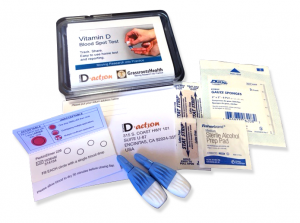
Measuring and calculating a supplementation amount to help reach and maintain a target level, or taking loading doses to correct deficiency faster, could possibly make all the difference in overall health, wellbeing, and how a current disease situation progresses. Test your level now!
Create your custom home blood spot kit by adding any of the following measurements, along with your vitamin D:
- Omega-3 Index (with or without Ratios AA:EPA and Omega-6:Omega-3)
- Magnesium (with additional Elements copper, zinc, selenium, mercury, and cadmium)
- hsCRP as a marker of inflammation and HbA1c as a marker of blood sugar health
Having and maintaining healthy vitamin D levels and other nutrient levels can help improve your health, now and for the future. Enroll and test your levels today, learn what steps to take to improve your status of vitamin D (see below) and other nutrients and blood markers, and take action! By enrolling in the GrassrootsHealth projects, you are not only contributing valuable information to everyone, you are also gaining knowledge about how you could improve your own health through measuring and tracking your nutrient status, and educating yourself on how to improve it.
How Can You Use this Information for YOUR Health?
Having and maintaining healthy vitamin D and other nutrient levels can help improve your health now and for your future. Measuring is the only way to make sure you are getting enough!
STEP 1 Order your at-home blood spot test kit to measure vitamin D and other nutrients of concern to you, such as omega-3s, magnesium, essential and toxic elements (zinc, copper, selenium, lead, cadmium, mercury); include hsCRP as a marker of inflammation or HbA1c for blood sugar health
STEP 2 Answer the online questionnaire as part of the GrassrootsHealth study
STEP 3 Using our educational materials and tools (such as our dose calculators), assess your results to determine if you are in your desired target range or if actions should be taken to get there
STEP 4 After 3-6 months of implementing your changes, re-test to see if you have achieved your target level(s)