

Published on September 10, 2025

A new study shows widespread deficiency of Omega-3 fatty acids and its role in global health and chronic disease
Key Points
-
- Omega-3s and inflammation — Omega-3s help resolve inflammation, stabilize cell membranes, and protect against oxidative stress.
- Global status — Average omega-3 levels are low worldwide, with the lowest in North America and the highest in Northern Europe, Japan, and Ghana.
- The omega-6:omega-3 ratio — Ideal ratios are 1–5:1, but many countries are at 8–11:1, promoting inflammation and higher risks of heart disease, diabetes, cancer, and autoimmune conditions.
- Supplementation works — Global study shows that omega-3 users had significantly higher blood levels (+1% on average) compared to non-users.
- Lifestyle factors — Women and older adults had higher levels, while overweight/obese individuals had lower levels.

A landmark 2025 study, analyzing over 590,000 dried blood spot (DBS) samples from around the world, has confirmed an unfortunate truth: most people are still not getting enough omega-3s. The findings show widespread low blood levels of EPA and DHA and an imbalanced omega-6:omega-3 ratio, fueling inflammation and increasing the risk for chronic diseases (Torrissen et al., 2025).
Why Omega-3 Balance Matters
Omega-3 fatty acids (EPA and DHA) are crucial for:
- Cardiovascular health — reducing arrhythmia risk, improving vessel function, lowering inflammation.
- Brain and cognition — supporting learning, memory, and mood regulation.
- Inflammation resolution — producing pro-resolving mediators that switch off excessive inflammation.
By contrast, excess omega-6 intake (from seed oils and processed foods) fuels pro-inflammatory prostaglandins and leukotrienes, tipping the body into chronic low-grade inflammation.
Modern diets have shifted the omega-6:omega-3 ratio from the ancestral 1–2:1 balance toward 10–25:1 — a level significantly linked to cardiovascular disease, diabetes, autoimmune disorders, and cancer. See the map below showing omega-6 to omega-3 ratios around the world from Torrissen et al.
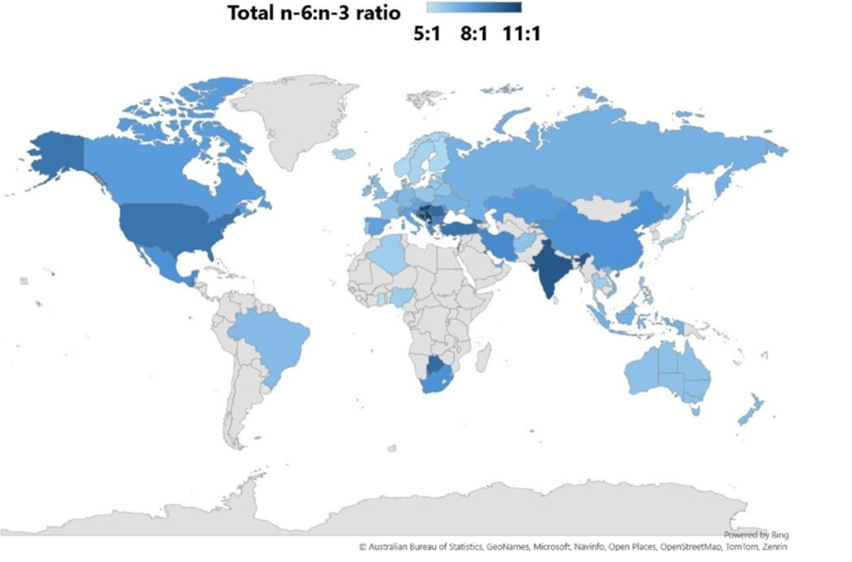
Darker shades indicate higher, more pro-inflammatory ratios (approaching ~11:1); lighter shades indicate healthier balance (near ~5:1). Source: Torrissen et al., 2025.
The Omega-3 Index: What the Global Data Showed
Lowest Omega-3 Index levels: United States (2.7%), Canada (2.9%), Hungary (2.4%).
Highest Omega-3 Index levels: Ghana (5.4%), Japan (5.1%), Norway (4.4%).
Differences by region:
- US, Canada, India, Hungary, Serbia — Among the lowest, with mean Omega-3 Index levels as low as 2.4–2.9% and omega-6:omega-3 ratios up to 11:1.
- North America and Africa overall — Lowest mean omega-3 levels and highest inflammatory ratios.
- Asia, Oceania, and Northern Europe — Higher omega-3 levels and healthier ratios.
- Ghana, Japan, Nigeria, Faroe Islands, and Thailand — Among the best, with Omega-3 Index levels above 5%.
Target for health: An Omega-3 Index of at least 8% is considered optimal, yet no region in this study reached that level.
Who has better levels?
- Supplement use was the strongest predictor of higher omega-3 levels; those who regularly took omega-3 supplements had significantly higher EPA + DHA levels than those who did not.
- Age showed a positive effect, meaning older adults tended to have slightly higher omega-3 levels.
- BMI mattered: individuals with higher BMI had lower omega-3 levels, even with supplement use.
- Sex differences were modest, but women had slightly higher omega-3 levels than men.
Potential Health Implications
- Cardiovascular protection — Populations with higher omega-3s (like Japan and Northern Europe) have lower rates of coronary heart disease.
- Inflammatory disease risk — High omega-6:omega-3 ratios (>10:1) are associated with higher rates of autoimmune disease, arthritis, and asthma.
- Cancer outcomes — More balanced ratios (closer to 4:1) have been shown to reduce mortality and slow tumor progression in several cancers.
- Longevity — Higher circulating omega-3 levels correlate with a 15–18% lower risk of all-cause mortality, particularly in those starting from low levels.
What Level Is Best?
Research indicates that maintaining an Omega-3 Index (EPA + DHA) of 8% or higher is associated with better health outcomes. However, this global study reported averages of only 2.4% to 5.4%, showing that most populations remain well below this goal.
For the omega-6:omega-3 ratio, the recommended range is 1:1 to 5:1. The study found observed values between 6:1 and 11:1, levels that may promote inflammation and increase risk for chronic disease.
Insights from GrassrootsHealth Participants
- Among GrassrootsHealth participants, the average Omega-3 Index is about 6.2%, with only 19% achieving 8% or higher.
- Repeat testers show progress, averaging 6.7%, compared to 5.8% for first-time testers suggesting that testing and adjusting intake over time can improve status.
- The Omega-3 Index test measures long-term intake (over approximately four months), making it a reliable marker of overall omega-3 status.
Practical Considerations
- GrassrootsHealth recommends retesting every 4–6 months to monitor changes and ensure levels remain within the optimal range.
- The Omega-3 Index Calculator can help estimate the daily intake of EPA+DHA needed to reach an 8% target. On average, about 1,300 mg/day of EPA+DHA raises 50% of individuals to 8%, while around 1,900 mg/day raises 90%. Because responses vary, testing remains the most accurate way to guide intake.
Takeaway: Balance is Key
This study, the largest of its kind, makes one thing clear:
- Omega-3 deficiency is a global problem.
- High omega-6 diets worsen chronic disease risk.
- Testing and improving omega-3 intake is essential.
Action Step: A simple finger-prick dried blood spot test can measure your omega-3 status and omega-6:omega-3 ratio – add the Omega-3 Index with Ratios to your home test kit with GrassrootsHealth. From there, you can adjust diet and supplementation to restore balance, protecting your heart, brain, and immune system.

Measure Your Levels Today – Save 15% when Measuring Your Omegas with OMEGA3S
If you haven’t had your levels checked recently, now is the time! With so many Americans still falling short, awareness is the first step toward change.

Create your custom home blood spot kit by adding any of the following measurements, along with your vitamin D:
- Omega-3 Index (with or without Ratios AA:EPA and Omega-6:Omega-3)
- Magnesium (with additional Elements copper, zinc, selenium, mercury, and cadmium)
- hsCRP as a marker of inflammation and HbA1c as a marker of blood sugar health
Having and maintaining healthy vitamin D levels and other nutrient levels can help improve your health, now and for the future. Enroll and test your levels today, learn what steps to take to improve your status of vitamin D (see below) and other nutrients and blood markers, and take action! By enrolling in the GrassrootsHealth projects, you are not only contributing valuable information to everyone, you are also gaining knowledge about how you could improve your own health through measuring and tracking your nutrient status, and educating yourself on how to improve it.
How Can You Use this Information for YOUR Health?
Having and maintaining healthy vitamin D and other nutrient levels can help improve your health now and for your future. Measuring is the only way to make sure you are getting enough!
STEP 1 Order your at-home blood spot test kit to measure vitamin D and other nutrients of concern to you, such as omega-3s, magnesium, essential and toxic elements (zinc, copper, selenium, lead, cadmium, mercury); include hsCRP as a marker of inflammation or HbA1c for blood sugar health
STEP 2 Answer the online questionnaire as part of the GrassrootsHealth study
STEP 3 Using our educational materials and tools (such as our dose calculators), assess your results to determine if you are in your desired target range or if actions should be taken to get there
STEP 4 After 3-6 months of implementing your changes, re-test to see if you have achieved your target level(s)